Monthly Archives: July 2021

Book Review: Elizabeth & Elizabeth by Sue Williams

I’ve been on a bit of a Elizabeth Macarthur odyssey ever since I read Michelle Scott Tucker’s book Elizabeth Macarthur: A life at the edge of the world. (See my earlier review https://sckarakaltsas.com/2020/05/22/book-review-elizabeth-macarthur-a-life-at-the-edge-of-the-world-by-michelle-scott-tucker/ ). When I heard about Elizabeth & Elizabeth, a fictional story about Elizabeth’s friendship with Elizabeth Macquarie, I had to buy the book.

Too many Elizabeth’s can be a bit confusing so I’ll use surnames. A young Mrs Macquarie was married to Lachlan Macquarie who came to Australia as the Governor of the new colony. He was a man of vision, providing the name of Australia and introducing social reforms to emancipate convicts despite strong opposition from the elite including Mr Macarthur. Williams imagines Mrs Macquarie to be a strong and assertive influence on Lachlan and credits her with imaginative ideas of architecture, garden landscaping as well as social welfare for young women.

Meanwhile Mrs Macarthur married to the troublesome, duel challenging at the drop of a hat, Mr Macarthur is much older and wiser not given to airs and graces while she’s grappling with a couple of sheep on the farm she’s managing because Mr Macarthur is in England sorting out the scraps he’s had with the previous Governor.

When she first arrives, Mrs Macquarie is portrayed as a wide-eyed and naïve young woman and I wondered if it might have been further from the truth given that she was thirty-one not twenty-one. But her character grows as she quickly adapts to the realities of the harshness of colonial life. She holds the much older Mrs Macarthur in high esteem. The relationship while brittle at first grows over the years as the challenges to the Macquarie’s post grows more difficult.

Of course, Mr Macarthur is as troublesome as history has portrayed. I’d always imagined that the relationship between Mr and Mrs Macarthur to be a difficult one with little love. Yet the author paints a loving and caring relationship between them. From what I’d read so far, I really doubted the woman could have done anything other than be relieved when he went to London for several years leaving her to make her mark on the colony with her sheep breeding ideas.

In reality, history being written by men provides us with little knowledge of the relationship between the two women but Williams reads between the lines to give us a delicious account of what these strong and intelligent women brought to society and to the foundations of the colony giving them credit when there’d been little before. No doubt there would have been few women from their class and they would have little choice than to fraternise despite their husbands opposing views of each other. I really liked the idea that women could come together to support each other enough to make the colony a better place. I can’t imagine how horrific it must have been to be a woman where childbirth and child raising was fraught with disease and death.   

The other great insight is just how entrenched the class system was adopted and continued on from England. It’s hardly surprising that the governing bodies, serving their own self-interests were mean-spirited about the people in the colony. But wait, what’s changed today with our present government? Perhaps not a lot when you consider the refugees who came here by boat.

This novel is rich in history, well-written and researched. If you’re after a bit of history about upper-class women of influence then check this one out.

Book Review: A Lonely Girl is a Dangerous Thing by Jessie Tu

I bought this book because of the hype around it. If I’d bothered to read the reviews, both supportive and divisive, I probably wouldn’t have read it. But this is a debut novel by a young Australian woman and I wanted to give it a go.

Jena Lin is a twenty-three-year-old classical violinist who as a child prodigy, toured the world. Something happened when she was fourteen and she stopped playing and embarked on a ‘normal’ life. Her relationship with her mother and mentor is fractured.  When she resumes her career, she is caught up in a world of rehearsals, performances and practice. In her spare time, she hooks up with just about anyone she meets using sex as a crutch to fill her loneliness.  When she is awarded an internship with the New York Philharmonic orchestra she begins to take control of her life and her comeback on her terms.

The book is essentially the blurb, reading almost like a diary of rotating daily activities of rehearsal, performance and sex, which in my opinion is overly graphic and gratuitous. There’s not much of a plot here and the sex scenes, and there was a lot, detracted from what was really going on with Jena.  There was little depth in her relationships and there was only just enough interest for me to find out about what had happened at fourteen. The world of the classical music lifestyle also held me to a point but I found that this too became repetitive.

The problem I had with the book was that while it was detailed in some aspects it was frustratingly short on depth in characters and Jena’s relationships. The characters almost seemed like cardboard cut-outs wheeled out at periodic times. As a reader we knew more about Jena’s day to day life than we did about much else.

On the day of the audition, I wake early to take a long shower, scrubbing off the residual sweat of sleep, washing my hair, shaving my underarms and legs. In the bathroom mirror, I squint at my own reflection.”

Trying to understand Jena, her motivations and the people around her was at times, quite bewildering. In particular, I would have liked to have known more about her relationship with her mother, and her father who is rarely mentioned. Half way through, I almost gave up but I slogged on hoping to get more than a superficial insight, even just a glimmer of emotion from just about anyone.  

Yet, I appreciated the themes the author was trying to explore, racism, sexism, female sexual desire, and loneliness. I’d never given a thought to classical music and in particular how most of it is written by men.

“I wonder why none of the music I play has been created by a woman and whether that exclusion was deliberate. What is the point of being any kind of artist if your skin colour or gender excludes you from the choices of old white men, just because you don’t look like them or they don’t see themselves in you?”

I didn’t mind the writing style and it’s slightly reminiscent of Sally Rooney’s Conversations with Friends. However, the characters are largely unlikeable and although there was some limited sympathy for Jena, the book left me frustrated and disillusioned. I know others liked it and but I don’t think it was for me. I guess I just wanted more depth.

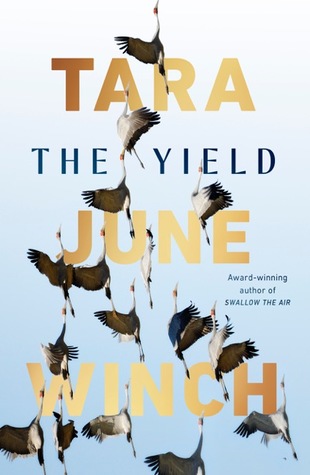
Book Review: The Yield by Tara June Winch

This highly awarded book is an evocative and eye-opening read from Australian (Wiradjuri) author Tara June Winch.

There are actually three stories all cleverly constructed to relate to each other:

Pop (Albert Goondiwindi) composes a dictionary of Wiradjuri words. He peppers the meanings with stories of his family, his past and his culture in the hope that none of it will be lost. He passes away before completing it.

The second story is from his granddaughter’s point of view. August flies home from England for Pop’s funeral and faces the family she ran from many years earlier.  She’s embraced by her grandmother and aunties and must confront the reasons for running away.

The third is a series of letters from Reverend Greenleaf of German background who set up a Mission for Aborigines in the late 1800’s.

This is a remarkably clever reconstruction of a history largely forgotten and untold in Australia. The dictionary was genius giving us a real sense of the Wiradjuri language including pronunciation. The focus on intergenerational trauma as well as the strength of connection to land and culture was inspiring.

Look at it this way – when people travel overseas the first thing, they do is learn a handful of words, learn the local language – please and thank you and hello and goodbye, maybe even where is the supermarket? People do it because it makes life easier but they also do it out of respect…

And then we’re all migrants here, even those first-fleet descendants, we forget we’re all in someone else’s country.”

Reading The Yield gave me all sorts of feelings. The anguish and anger of what happened to our indigenous people was detailed in the letters written by the Reverend. His seemingly good intentions to set up a mission under the guise of removing a long-established culture to impose another was incredibly misguided. But this is what he and most missionaries around the world have done. Even so, his so-called protection was never enough.

Then there was the sorrow about the loss and trauma experienced by August: her missing sister, not knowing what happened and the affect it had on her for years afterward, her emptiness and lack of belonging to the land or to her people.

The disgust about how we treat the fifty-thousand-year-old indigenous history. If we dug up a Roman building, we’d revere it yet that history is new in comparison to what exists in Australia. Who can forget Rio Tinto blowing up a 46-thousand-year-old sacred site only last year? And the novel’s story parallels this when the land that Pop had lived on and loved was sold off for a tin mine.

This is another great novel for all Australians to read. These stories help us to understand. Please check this one out.