Monthly Archives: December 2021

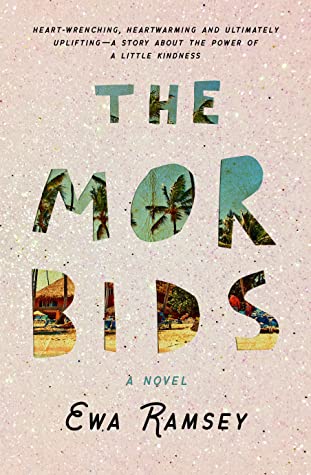
Book Review: The Morbids by Ewa Ramsey

The Morbids is a story about Caitlin, a young woman, convinced that she’s going to die. She joins a support group of people each of whom have their own issues about death and name themselves The Morbids. What has happened to Caitlin unravels slowly and painfully as we take the road with her towards healing and a better life.  

It’s a sad story yet an uplifting one too. Caitlin has suppressed her feelings after an accident where she blames herself for the death of someone. She copes as best as she can, throwing in her high-power job for a waitressing role, moving to a sordid neighbourhood and turning her back on her friends and family. She believes she is coping with the help of the support group but slowly she begins to unravel bit by bit.  Ever fearful, she avoids rather than confronts.

The impact of mental illness particularly trauma, anxiety and depression are important issues and the author does a superb navigating the reader through it in a very sensitive and touching way. There is no sugar coating so it is quite confronting. Not to say that it is all doom and gloom. There are shades of humour, love and joy. And then there are the moments of kindness, random and otherwise from people in Caitlin’s life. This character is very well drawn, complicated and multi-dimensional.

I also enjoyed the side characters from those in the help group to the ones in Caitlin’s work life. Along the way we meet caring Nic, her boss at the bar where she works; concerned Lina the best friend she’s avoided since the accident two years ago and the gorgeous Tom, the emergency doctor. They all played their part superbly.

The second half is quite intense and I wasn’t sure where it would go but I hoped that Caitlin would be okay. Take a look and see for yourself.

Book Review: The Vanishing Half by Brit Bennett

I’ve heard a lot about this book and I’m in two minds about it.

Identical twins, Desiree and Stella grow up in a southern black community. What’s different about this community is that everyone is light-skinned including the twins. When they turn sixteen, they run away. Soon after, Stella leaves her sister and submerges herself into a white world where she marries and lives as a white woman. She carries her secret, lying about her origins to her husband and only daughter, Kennedy. Desiree is heart-broken when Stella disappears and forges a life without her. She marries a black man and has a daughter, Jude who looks like her father. The marriage breaks down and Desiree goes back to her mother and the community with Jude.

This is a fascinating premise and the themes of race, class and identity are beautifully explored. There were other themes too such as transgender and domestic violence. There are several timelines beginning in 1968, when Desiree returns. Then it ends in 1986 when the two daughters, Kennedy and Jude cross paths with interesting consequences.

This is a big story and could have easily been made into a series. The author takes us through the twin’s childhood, and their initial estrangement from their mother. And although ten years later, Desiree returns to her mother, there’s a gap about Stella and her mother’s relationship. How could Stella disappear without a trace? What guilt did she carry and how did she live with that? By the time we get to Stella’s point of view we are given answers, yet I found I wanted more. And herein lies the dilemma of hiding deep family secrets as well as Stella’s own childhood trauma. Her white husband appears to be totally clueless yet Stella’s fear of being found out might surely have had a toll.

The relationship between Jude and her boyfriend Reece, a trans-man was tender but again, this was another book in itself as was Kennedy’s story. Well, done to the author for trying to contain all of these stories of what is essentially an epic family story.

Yet, perhaps because it is such a big story, I found it hard to engage with the characters as much as I would have liked.  I think I might have enjoyed it more if it was told in first person rather than omniscient as it felt a little removed for my taste.

Otherwise, it’s definitely a well-written story worth reading and appreciating given the themes.