Category Archives: Book reviews

Book Review: The Vanishing Half by Brit Bennett

I’ve heard a lot about this book and I’m in two minds about it.

Identical twins, Desiree and Stella grow up in a southern black community. What’s different about this community is that everyone is light-skinned including the twins. When they turn sixteen, they run away. Soon after, Stella leaves her sister and submerges herself into a white world where she marries and lives as a white woman. She carries her secret, lying about her origins to her husband and only daughter, Kennedy. Desiree is heart-broken when Stella disappears and forges a life without her. She marries a black man and has a daughter, Jude who looks like her father. The marriage breaks down and Desiree goes back to her mother and the community with Jude.

This is a fascinating premise and the themes of race, class and identity are beautifully explored. There were other themes too such as transgender and domestic violence. There are several timelines beginning in 1968, when Desiree returns. Then it ends in 1986 when the two daughters, Kennedy and Jude cross paths with interesting consequences.

This is a big story and could have easily been made into a series. The author takes us through the twin’s childhood, and their initial estrangement from their mother. And although ten years later, Desiree returns to her mother, there’s a gap about Stella and her mother’s relationship. How could Stella disappear without a trace? What guilt did she carry and how did she live with that? By the time we get to Stella’s point of view we are given answers, yet I found I wanted more. And herein lies the dilemma of hiding deep family secrets as well as Stella’s own childhood trauma. Her white husband appears to be totally clueless yet Stella’s fear of being found out might surely have had a toll.

The relationship between Jude and her boyfriend Reece, a trans-man was tender but again, this was another book in itself as was Kennedy’s story. Well, done to the author for trying to contain all of these stories of what is essentially an epic family story.

Yet, perhaps because it is such a big story, I found it hard to engage with the characters as much as I would have liked.  I think I might have enjoyed it more if it was told in first person rather than omniscient as it felt a little removed for my taste.

Otherwise, it’s definitely a well-written story worth reading and appreciating given the themes.

Book Review: Bowl the Maidens Over by Louise Zedda-Sampson

It’s often been said by friends and family that I don’t have a sporting bone in my body. There is, however nothing wrong with my appreciation of history particularly when it comes to women’s place in it. And I was delighted to pick up a book about the first female cricketers in Australia and more specifically in my home state of Victoria.

Bowl the Maidens Over helps us understand how women came to play what was originally known as a man’s game. Yet as a man’s game there’s no physical barrier for a woman to play. I have been known to play the game with men and although I have no real talent, I can bowl, bat and throw the ball, well perhaps not terribly well. I can also appreciate the strategy and of course the thrill of being on a winning side.

In fact, whenever women have made the initial attempts to play a man’s game there has always been opposition and derision. Who can forget that not long ago— read within the last ten years —when women’s football in Australia was greeted with great uncertainty? Indeed, the first sold-out match with a crowd outside the stadium floored the male dominated organisers. The innuendo and vitriolic comments on social media platforms could only be described in the sea of positive comments as vile and nasty.

Not much has changed since a group of women in 1874 played an exhibition cricket match to raise funds for charity. Where did they play? In the town of Sandhurst, now known as Bendigo. It was a match attended by thousands and soon after the initial praise, some media whipped up a storm about how unladylike these women were, describing their attire rather than their skill. Oh goodness, what a shock it must have been when ‘they paraded their ankles to the public gaze’ or engaged in ‘an unwomanly game.’

This small delightful volume packs a punch of history giving us a brilliant snapshot of an unknown group of pioneering women who dared to take on a sport with skill and talent. Zedda-Simpson does a fantastic job of weaving the narrative around the media’s debate about the match. Although we don’t really know how the women felt about the attention, the author gives us an insight by revealing the flurry of forthright and entertaining letters to the editor.

A really good read even if it does make you feel indignant about how far we have still yet to go.

Check it out. Bowl the Maidens Over

Author interview

I was recently interviewed about my latest book, The Good Child. You can check it out below.

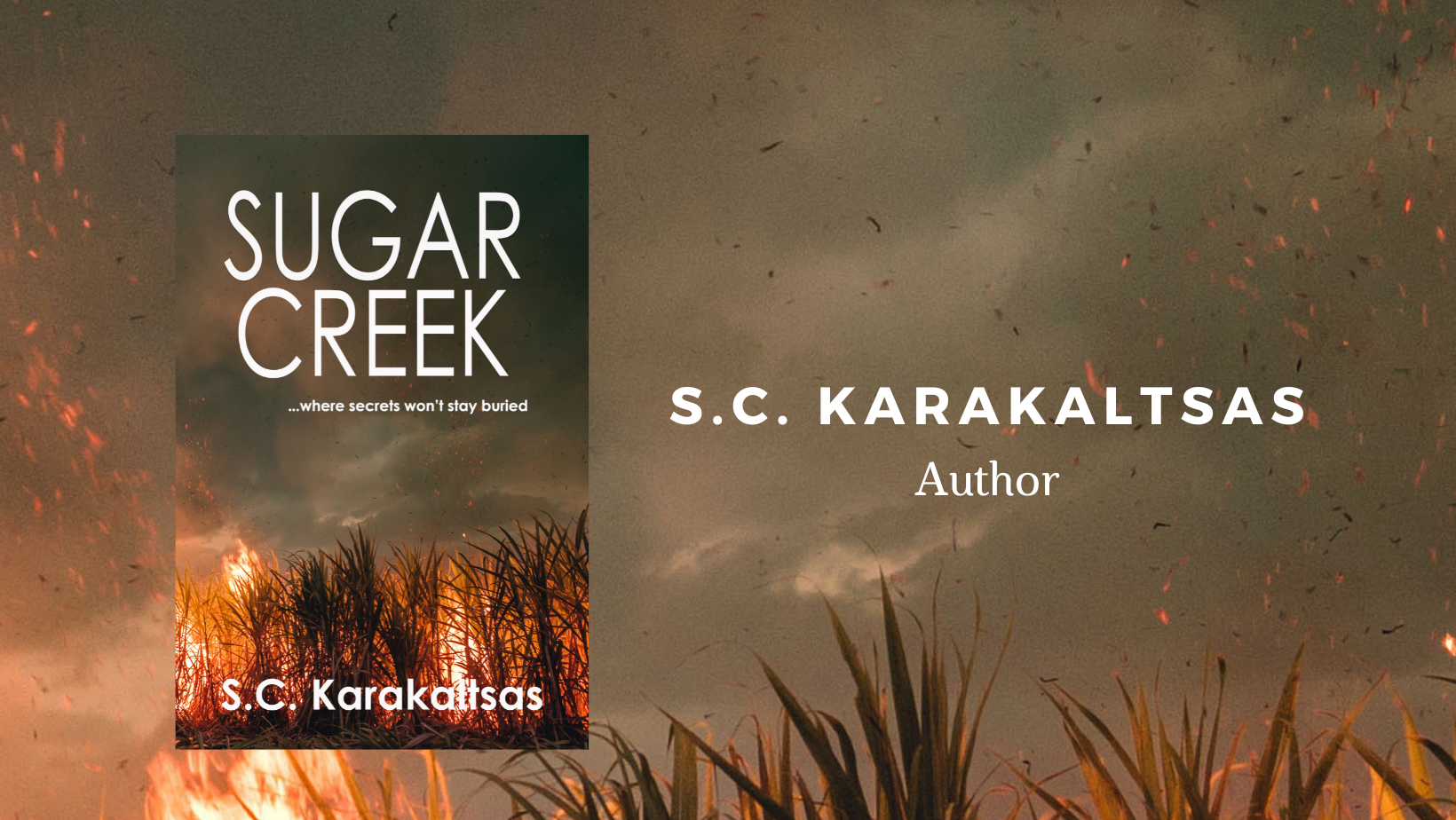
Historically, men have power over the lives of both nations and women. Commerce and politics are traditional realms of masculine influence in cultures worldwide. The latest Australian historical fiction by S.C. Karakaltsas (see my review here), The Good Child explores the public and private aspects of how the behaviour of some influential men affects their loved…

The Good Child: exploring how power is shaped — Clare Rhoden

Book Review: The Other Side of Beautiful by Kim Lock

Pic courtesy of Goodreads

What a charming read this one was despite the subject matter and perfect for an escape from Melbourne’s interminable lockdown.

We meet Mercy a woman who in the first chapter is thrust out of her burning home in the middle of the night and with nowhere to go finds herself back in her ex-husband’s house with his unwelcoming partner. She is a woman riddled with grief, anxiety and panic attacks but finds herself way out of her comfort zone when she purchases a run-down campervan and takes off from Adelaide for a three-thousand-kilometre trip through outback Australia.

The opening line packs a punch compelling you to read on and on. “Mercy Blain’s house was on fire, but that wasn’t her biggest problem.”

And we wonder what her biggest problem is and how she got into her predicament. It’s a road trip of stunning landscape but it’s also a journey of healing as Mercy meets her fears head on in order to survive. Little by little the reader gains an understanding of Mercy, willing her on despite the obstacles of a huntsman spider passenger, an unreliable vehicle, the cremated remains of unknown woman, dubious phone reception and of course, a journalist who had humiliated Mercy in the media. Along the way she meets other campers, grey nomads and a young Scotsman who all try to help in their own friendly ways.

The other star of this novel is Wasabi, a sausage-dog whose personality and love for Mercy is very touching. Not being a dog lover myself, I was almost yearning for my own Wasabi by the time I finished this book. You can’t help but fall in love with him.

As for the journey, it’s a wonderful travelogue of a part of Australia I have yet to visit. And yes, I’m planning my own trip and with the help of a very handy map at the beginning of the novel, it should be easily achievable. Oh wait, I still have to get a very old campervan. Perhaps another mode of transport then instead?

A very enjoyable book to read and a terrific advertisement for travel up the middle of Australia.

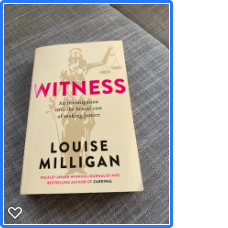
Book Review: Witness by Louise Milligan

Witness is an important book to read as it exposes gaps in Australia’s legal system.

Louise Milligan is an incredible investigative journalist who has spent years reporting on sexual abuse crimes. Her latest book exposes the toll on victims (known by the legal system as witnesses perhaps to dehumanise them) who attempt to seek justice using that very system. Milligan knows only too well what the experience is like when she took the stand in the case of George Pell’s trial. And although she was not a victim, the process she went through to protect those who had entrusted her with their experiences took a toll. She questioned that if she with resources and skills found the whole thing traumatic, what then of the actual victims of sexual abuse. And what she finds is enough to turn off most except for those who have the strength to take on their perpetrators.

Milligan’s interviews with barristers, judges, defence counsel, and victims together with meticulous research including transcripts, reveal how the wheels of justice operate, and it’s not pretty. It’s brutal and terrifying and more so for the victims who face the system.

“A system where, even if they received what is considered to be justice, they came away from the experience worse than when they went into it.”

 Milligan gives us Saxon Mullins case, a young eighteen-year-old girl raped in an alleyway. The trial itself raised the issue of what is consent but more importantly, what Saxon went through for five years to see her rapist brought to account can only be described as horrendous. The adversarial role the defence counsel uses to discredit, nit-pick and dehumanise a rape victim is put on show with Mullin’s case.

Then the legal system itself is dissected where the pattern of male patriarchy is still strong, where although numbers of women are growing, it’s an industry of self-employed barristers whose livelihood gives little encouragement for the female barrister who has a family or wants one.

Then there’s the environment of the legal industry and the challenges women face as workers. Who could forget Dyson Heydon who sexually harassed several women whilst serving as a High Court judge?

And Peter O’Callaghan QC who was on a retainer for the Catholic Church to manage their response to the hundreds of allegations of sexual abuse by members of the catholic church. A man who received $7.8 million in remuneration from the Catholic church from 1996 to 2014 to administer and hand out compensation of a mere $9.7 m with an average of $32k for each survivor of paedophile priests. Few were recommended for police investigation.

“For victims of sexual crimes, the unquestioning decision to use O’Callaghan’s name for their gallery speaks volumes about the Victorian Bar’s attitude to victims of sexual abuse.”

Milligan paints a vivid picture of what being a witness is like even through her own eyes on the witness stand where the barrister was aggressive, demeaning and disrespectful. Or the room she explains where they put child victims who aren’t allowed to have their dolls or teddy bears in case that should remind the jury that the victim is indeed a child.

Milligan has also endured threats to her life and online twitter trolling yet without people like her, nothing would ever change. And change is happening and Mulligan give us a glimmer of hope that eventually perpetrators of sexual abuse will be brought to account and victims will be treated with care and compassion and consideration of the trauma they’ve gone through.

This book doesn’t hold back. It’s confronting, gripping, eye-opening and terrifying making you think twice about raising a complaint of sexual abuse. Which makes it even more incredible that victims who go through the court system must surely be lauded as true heroes. I thank Louise Milligan and every other investigative journalist who has ever put themselves out there. What they do is enlighten and educate us so that we can stamp our feet and yell out loud to get things changed. This is an important book for everyone to read.

Book Review: Wimmera by Mark Brandi

I was totally unprepared for this unexpected story.

The blurb, (which I rarely check before diving in) is about two young boys, Ben and Fab, who in 1989 do all the things youngsters do; play cricket, go yabbying and camping. They talk about all sorts of things except for how Fab’s dad hits him or what happened to the girl next door. When a new neighbour moves in, their imagination soars wondering if he’s a secret agent. The opening scene is the discovery of a drum in the local river.

It’s a moody book and the first half is pretty much about the boys’ everyday lives from Ben’s point of view with a slow build of tension and foreboding when they meet Ben’s far too friendly neighbour.  Half way through the novel, Ben’s voice disappears and we’re propelled into the future almost twenty years later into Fab’s point of view. Fab still lives in the same country town, lost and alone working in a supermarket and we’re left to wonder what happened to Ben.

The second half takes on a sense of urgency and the story unfolds in a very unsettling way.  I appreciated the second half far more than the first. There was much left to the readers imagination and for the reader to piece together and I liked that. The last couple of chapters was dramatic and a page turner.

The subject matter isn’t for the faint-hearted and there’s no trigger warning about child abuse. But if you can see your way through the dark subject, it’s a very decent debut.

Book Review: Honeybee by Craig Silvey

A masterful tale of what it is to be different, down and out yet surrounded with hope and the goodness of the human spirit.

Honeybee comes from the author of the much-acclaimed Jasper Jones and is not a disappointing read. It’s uncomfortable at times and heart-wrenching, yet has a soul. Its spotlight has no doubt raised incredible awareness into a little-known community who is still finding its voice.

Sam Watson the main character, is a fourteen-year-old who meets Vic, on a bridge. They’re both there for the same reason and an unlikely friendship ensues brought about by a shared bond of their individual suffering. Through Vic, Sam learns acceptance and sets him on a path toward a better life. But Sam also gives something to Vic.

It’s a coming-of-age novel full of petty thefts, extortion plots, botched bank robberies, drag shows and Julia Child’s inspired cooking. But more importantly, it’s a novel of wonderful characters.

Firstly, there’s the sensitive, naïve but heart of gold, Sam. His journey to find himself and learning to live with who he truly is, is beautifully done. Then there’s Vic, who with the help of Sam finds redemption for something he’s lived with his entire life. His love for his wife Edie is touching and the care Sam shows Vic and Edie is very moving. Next, there’s Aggie, a full of life teenager who doesn’t give a damn about what Sam looks like. She sees him for who he really is, knowing him more than Sam himself. There’s Peter, the drag queen who helps pick up the pieces, who extends a hand and role models how life could be for Sam. His mother Sarah, is a difficult character to warm to yet drawn out enough to allow us to understand her much difficult path in life and the choices she made.

It’s a rollercoaster ride of emotion, dark and light, despairing yet hopeful and a great read against the backdrop of beautiful Perth. Put this one on your list.