Category Archives: Book reviews

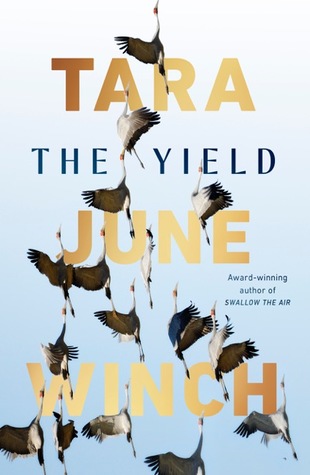
Book Review: The Yield by Tara June Winch

This highly awarded book is an evocative and eye-opening read from Australian (Wiradjuri) author Tara June Winch.

There are actually three stories all cleverly constructed to relate to each other:

Pop (Albert Goondiwindi) composes a dictionary of Wiradjuri words. He peppers the meanings with stories of his family, his past and his culture in the hope that none of it will be lost. He passes away before completing it.

The second story is from his granddaughter’s point of view. August flies home from England for Pop’s funeral and faces the family she ran from many years earlier.  She’s embraced by her grandmother and aunties and must confront the reasons for running away.

The third is a series of letters from Reverend Greenleaf of German background who set up a Mission for Aborigines in the late 1800’s.

This is a remarkably clever reconstruction of a history largely forgotten and untold in Australia. The dictionary was genius giving us a real sense of the Wiradjuri language including pronunciation. The focus on intergenerational trauma as well as the strength of connection to land and culture was inspiring.

Look at it this way – when people travel overseas the first thing, they do is learn a handful of words, learn the local language – please and thank you and hello and goodbye, maybe even where is the supermarket? People do it because it makes life easier but they also do it out of respect…

And then we’re all migrants here, even those first-fleet descendants, we forget we’re all in someone else’s country.”

Reading The Yield gave me all sorts of feelings. The anguish and anger of what happened to our indigenous people was detailed in the letters written by the Reverend. His seemingly good intentions to set up a mission under the guise of removing a long-established culture to impose another was incredibly misguided. But this is what he and most missionaries around the world have done. Even so, his so-called protection was never enough.

Then there was the sorrow about the loss and trauma experienced by August: her missing sister, not knowing what happened and the affect it had on her for years afterward, her emptiness and lack of belonging to the land or to her people.

The disgust about how we treat the fifty-thousand-year-old indigenous history. If we dug up a Roman building, we’d revere it yet that history is new in comparison to what exists in Australia. Who can forget Rio Tinto blowing up a 46-thousand-year-old sacred site only last year? And the novel’s story parallels this when the land that Pop had lived on and loved was sold off for a tin mine.

This is another great novel for all Australians to read. These stories help us to understand. Please check this one out.
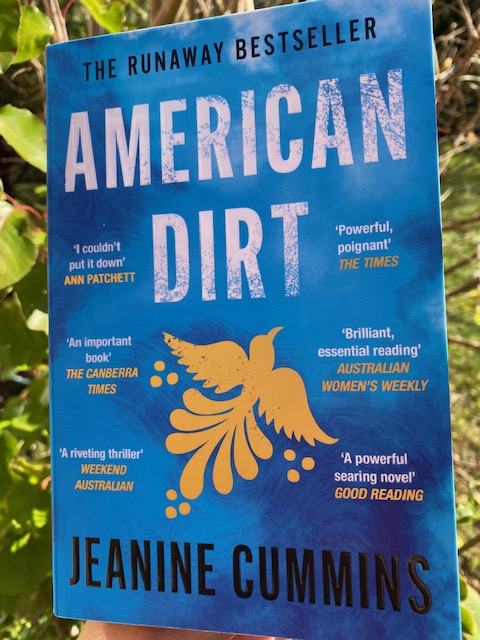
Book Review: American Dirt by Jeanine Cummins

This is a heart-thumping, gripping story about a woman and her son running for their lives from a murderous drug lord.

Lydia Perez, a book shop owner in Acapulco lives with her journalist husband and eight-year-old son, Luca. After her husband writes a story about the leader of a drug cartel who had unknowingly formed a friendship with Lydia, revenge is sought and he murders all of her family. Lydia and Luca, the only survivors flee for their lives and commence the hazardous and tortuous journey to the USA.

This is ultimately a story of survival as refugees. The UN Refugee Agency estimates as at 30 June 2020 that the number of people forcibly displaced is now at 80 million with over 26 million refugees.

Cummins shines a light on one part of the world where the flow of refugees is not just from Mexico but from countries to the south, where drug lords’ rule and government corruption is rife. It’s an incredibly moving, yet gripping account of Lydia’s and Luca’s survival and the refugees they meet along the way. It also highlights the problems of ‘that wall’ so controversial in the USA.

‘None of it is funny to Lydia. She hadn’t been naive enough to think they were in the clear yet, but she did think the nature of the most pressing threat would’ve changed by now. She thought that … she’d have to worry more about Border Patrol, about the possibility of Luca being taken from her, and less about random men with guns enforcing their own decrees … She knows that anyone they encounter here, in this wild, desolate place, would mean the end.’

The story although fictional, forces the reader to relate to refugees as human beings. What compels a person to leave everything behind to take such a hazardous and arduous journey? It’s quite simple: desperation. The mean-spiritedness of some governments around the world is deplorable yet the plight of refugees continues without solution.

This is an unputdownable, nerve-wracking, tension-packed novel, yet it provides hope and inspiration. The character of Luca, in particular is very well drawn and the courage and bravery of the child is truly breath taking. The other characters, Lydia, Rebeca and Soledad are more than characters. They are people we care about, wanting them to be saved and to have a better life.

Do Lydia and Luca actually make it across the border? You’ll have to read it for yourself.

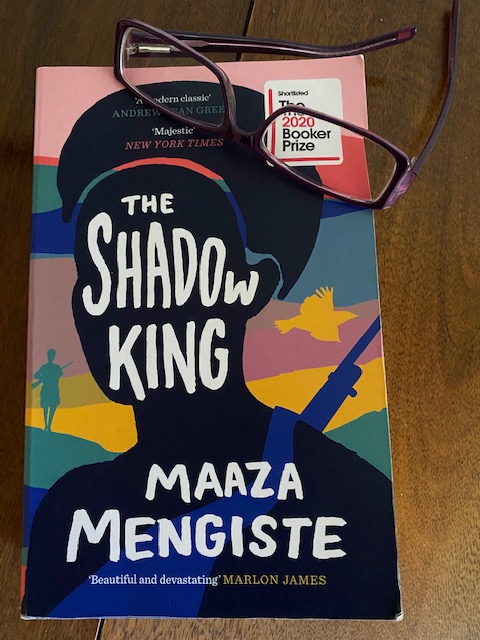
Book Review: The Shadow King by Maaza Mengiste

Short listed for the Booker Prize in 2020, this is a fascinating and insightful epic about the Italian invasion of Ethiopia in 1935.

It opens with Hirut, an older Ethiopian woman travelling on a bus in 1974 through a troubled Addis Ababa. She’s on her way to take a box of photos to Ettore, a man who’d once been her jailer after her capture by Mussolini’s army.

The story takes us back to just before the Italian invasion when as an orphan, Hirut is taken in as a reluctant servant to Kidane and his wife Aster. When Kidane, an officer in the army mobilises troupes to fight, strong-willed Aster galvanises all the women in the district to help and Hirut transforms from servant to fierce warrior.

 The Emperor, Haile Selassie flees the country and when all hope appears lost, Hirut suggests disguising a peasant as the emperor to fool the Italians and inspire the Ethiopian army to continue the fight. Hirut is eventually captured and embroiled in her own personal war against her captors, one of which is Ettore.

It’s an incredibly written and lyrical novel on a brutal and horrific subject. Mengiste’s descriptions are poetic and I’d suggest you ignore the absence of some punctuation and enjoy the writing.

“She is close enough to see him racing across the spine of the mountain, his heels flying, that chest a swell of bony ribs and heavy air. In the ebbing night, he comes first as sound: the snap of a branch, a scrape of foot on stone. A hiss curving against the soft orange light. He is a fleeting mirage speeding over rough hills, shallow gasps stalling in thick breeze.”

The history is rich giving us insight into both sides of this little-known war of which I was totally ignorant. The author explores the bravery and sheer persistence by the Ethiopians in particular the power of their female soldiers. Mostly told from Hirut’s point of view, we are also given insight into other characters such as Ettore and Selassie who are rich and complex. The themes are numerous: trauma, survival, forced marriage, and colonisation to name some. Interestingly, Mengiste’s own great-grandmother had been a soldier and presumably provided her inspiration.

It’s a wonderfully enlightening and moving account of war fought by strong courageous women. Check it out.

Book Review: The Dictionary of Lost Words by Pip Williams

Intricately researched, this novel explores the making of the Oxford Dictionary. It’s an epic story taking in the years between 1886 and 1928 which is how long it took Professor John Murray and his team of editors, lexicographers and assistants to laboriously put it together via the help of thousands of people around the world who sent in words for inclusion.

The story revolves around Esme Owen who as a five-year-old, sits under the desk while her father and others work on the dictionary compiling, collating and making decisions about words on slips of paper and their definitions. One day, a slip with the word bondmaid, falls to the floor and little Esme scrambles to collect it and instead of giving it up, she stores it away like treasure. From that point, she observes the workers, collecting discarded slips with words which were deemed not to be worthy of inclusion. As she grows up, her secret collection of words grows and she begins to question and wonder why so many discarded words happened to be used by women.

“there is no capacity for the Dictionary to contain words that have no textural source. Every word must have been written down, and you are right to assume they largely come from books written by men.”

Esme is passionate about words and begins her research at local markets searching for words used by everyday women. Her best friend is Lizzie, a maid for the Murray family and she harbours Esme’s secret treasure supporting her friends’ quest but also questions some of her actions.

 The writer skilfully weaves in key historical events such as the women’s movement for the right to vote, class distinction, and World War One. Esme’s life is fictional yet some of the supporting characters are real and reimagined by the author to give us a sympathetic taste of what they might have been like.

I love the idea of language shifting and changing and the recognition that a dictionary can never be static as new words are constantly evolving every day. And what a challenge that must be to keep up to date.

“I spend my days trying to understand how words were used by men long dead, in order to draft a meaning that will suffice not just for our times but for the future.”

It’s a long, slow read at first and action is driven by Esme’s love for words and her observations and at times I wondered if my interest could be retained. It’s as a grown woman that things take a turn with Esme and not always for the better. It was easy to be swept up by the events some scandalous and other deeply moving.  I did find myself wanting to know more about Esme’s hopes and wishes for herself but it moved little beyond her work on the dictionary. I also loved Lizzie and her down to earth nature yet I earned to learn more of her hopes and dreams. However, the real main character must surely be the dictionary itself with a glimpse into the lives of the characters it affected.

I enjoyed this book perhaps even more so because I’d seen the movie entitled The Professor and the Madman based on the book The Surgeon of Crowthorne and I was already in awe of how the dictionary came about. The Dictionary of Lost Words took on a whole new perspective which I appreciated enormously. The research was meticulous, the writing beautiful, and methodical. Check this one out.

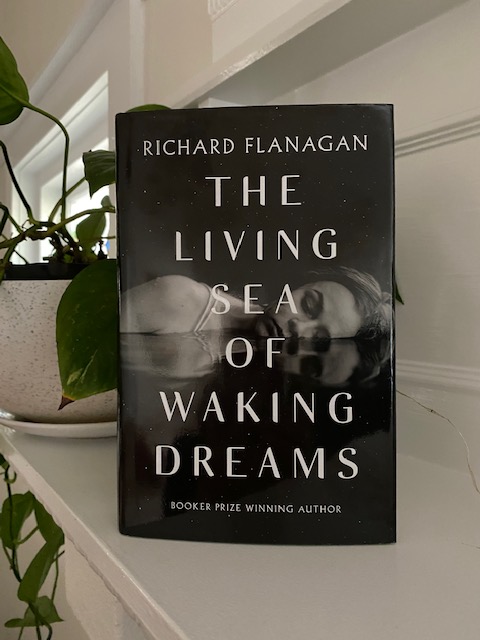
Book Review: The Living Sea of Waking Dreams by Richard Flanagan

The Living Sea of Waking Dreams is ideal for a book club as there’s so much in it to discuss.

Thoughtful, as it is thought provoking, Flanagan challenges the reader to think, to feel and to pay attention. What about? Death not just our own, but others, of the planet and our way of life. And the themes are wrapped around aging, displacement, child and elder abuse, trauma and environmental destruction. It’s not a happy book nor is it meant to be.

Flanagan cleverly uses the slow and excruciating demise of Francie, the mother of Anna, Terzi and Tommy. Terzi in particular, and Anna decide that it’s not time for their mother to die and do everything they can to keep her alive, against the wishes of Tommy her carer, as well as Francie. Their brutal decisions have a background story for their motivation.

‘They saved her from death, but only, thought Anna, by infinitely prolonging her dying. ‘

Many of us are facing the dilemma of aging parents and what might be best for them. At the core of this, is listening and respecting our parents’ wishes and not impaling them with our own controlling ideas. Flanagan explores the family dynamics beautifully to bring about a strong emotional and sometimes, uncomfortable response for the reader.

Anna finds parts of herself vanishing starting with her finger and nobody notices. Perhaps a metaphor for the fact that no-one notices the disappearance of animal species and habitat across our planet?  Told from Anna’s point of view we feel her dismay, her displacement and her own disappearing. I wondered whether like so many middle-aged women she also felt ignored, irrelevant and dismissed as if her voice no longer matters.

And there’s the issue of what social media is doing to us. When Anna is confronted by difficulties, she escapes into an alternative life of social media, to ignore and hide from herself, her family and what’s happening around her.

 “Instagram, blessed Novocaine of the soul! Foodholidayssmilinggroupsshopping. She had to get off. She knew it. She had to get off.”

Alongside this story is a commentary of what’s happening in the world from the extinction of the orange- bellied parrot to the destruction of swathes of habitat. Fires raged in Australia destroying more than a million animals. I well recall the devastation, the smoke, the fear last year, and Flanagan brought it all back, making us pay attention to our uncertain future and the fact that we are sitting atop a climate emergency yet no-one is truly taking notice.  

Flanagan has got a lot to say in this book and certainly his words pack a punch in an interesting way. The ending was profound, moving and powerful with a glimmer of hope and goodness inspiring us all to each do our bit. It’s not an easy read but it’s an important one leaving its mark on you.

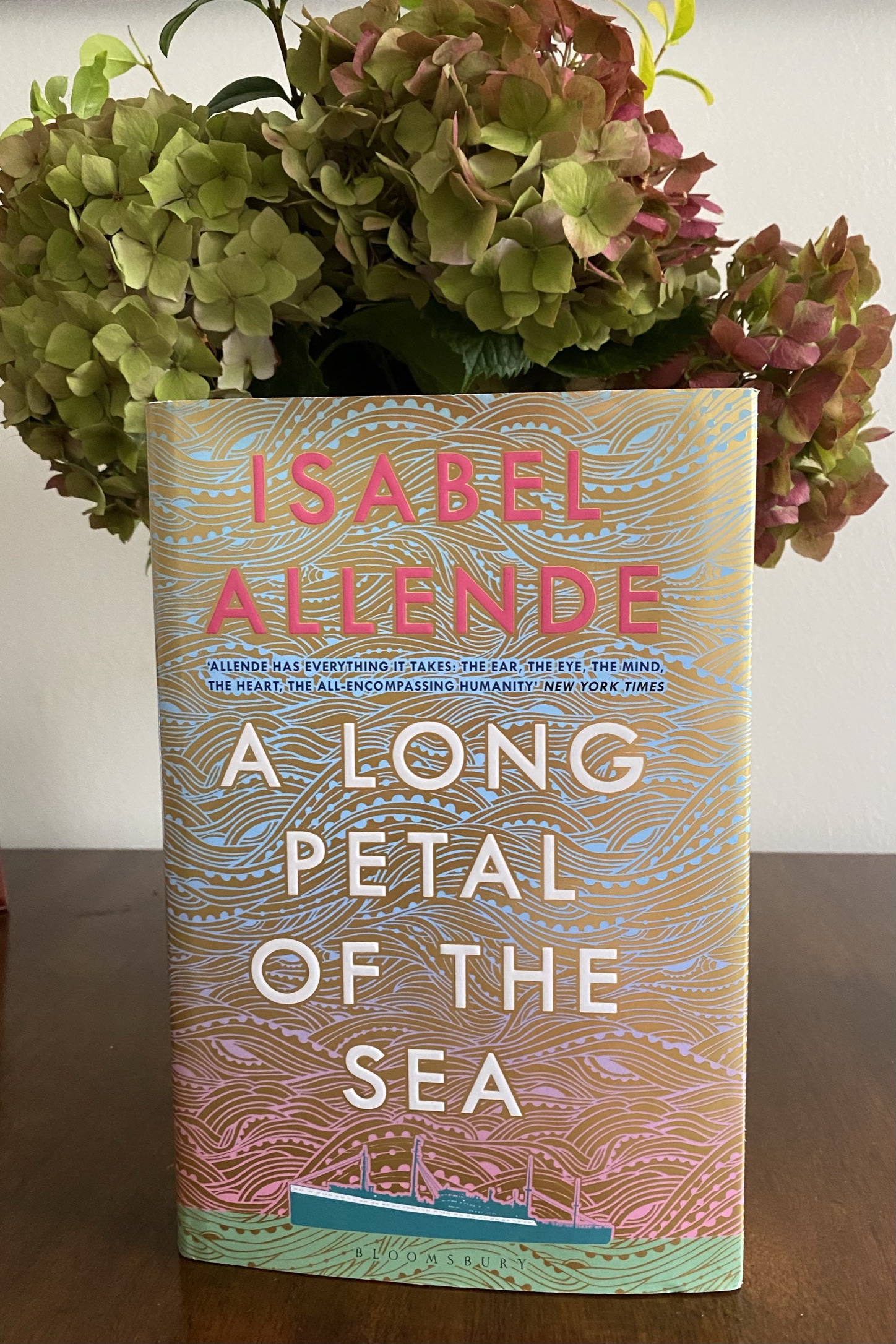
Book Review: The Long Petal of the Sea by Isabel Allende

This book is a fascinating look at history spanning fifty years of Victor Dalmau’s life. He was a young doctor in the Spanish Civil War who fled to a concentration camp in France. Together with Roser his brother’s pregnant wife, they take a ship chartered by the poet Pablo Neruda and sail to Chile where they settle.

Although fiction, it is written in a non-fictional style and is rich in true historical events surrounding the main characters of Victor and Roser. The horror of the Spanish Civil War is played out from Victor’s point of view from the brutal conditions of the war zone to the struggle for survival and escape. I knew little of this war and was fascinated to learn more.

‘Hundreds of thousands of terrified refugees were escaping to France, where a campaign of fear and hatred awaited them. Nobody wanted these foreigners – Reds, filthy, deserters, delinquents, as the French press labeled them… No-one imagined that within a few days there would be almost half a million Spaniards, in the last stages of confusion, terror and misery, clamouring for the border.”

The skill of Allende is that she is able to transport us through history, teaching and enlightening us about Spain, Chile and also Venezuela, putting us into the lives of the characters so that we know their fear, their pain and their anxiety. Yet despite the tragedies, there is love. And the love which grows between Victor and Roser is beautifully done.

Other characters such as the Del Solar family reflect the class divide between rich and poor in Chile, a legacy still felt today in this troubled country. Characters such as Ofelia Del Solar who tries to escape her domineering father, Victor’s friend Aitor who helps Roser, Victor’s mother Carme, Juana the nanny; each have their own stories weaved throughout the narrative of Victor and Roser’s life.

Some might be put off by the expositional style of writing but it didn’t bother me in the slightest. It’s easy to read, highly enlightening and sweeps you along. Give it a go.

Book Review: The Silent Listener by Lyn Yeowart

I turned the last page a few days ago and this book hasn’t left me alone to think about anything else other than the characters and the page turning story.

The first line “the moment he dies, the room explodes with life”, pulls you in and propels you through three time zones, 1940’s, 1960’s and 1983. Each chapter highlights which character it’s about and when, so it’s not difficult to follow.

The main character Joy returns after a long absence in 1983 to nurse her dying father, George, a highly respected and upstanding citizen of the rural community of Blackhunt. Alex Shepard, the local policeman, suspects foul play when George is found with a belt pulled tight around his neck and we’re left wondering if Joy has done it.

We’re then propelled back in time to George’s marriage to Joy’s mother Gwen, their whirlwind courtship, the run-down dairy farm she lives in and how she survives her new life.  It’s through eleven-year-old Joy’s eyes in December 1960 that we learn about her fixation with words, about her religious father and his abusive consequences on Joy and her siblings. In particular, Joy’s special relationship with her older sister Ruth is fascinating as it is revealing.

“Joy knew she should feel sorry for Ruth, but the truth was she felt a familiar white tremor of jealousy.”

Beyond that we get a strong sense of the community and the era particularly when nine-year-old friend, Wendy who lives on a neighbouring farm disappears and is never found which haunts the same investigating policeman, Alex Shepard twenty years later.

The novel is divided into four parts and the first half slowly but intricately unveils the many secrets of Joy’s family sucking the reader into a web of intrigue. A few twists and turns threw me into an unexpected direction culminating in an ending I had no idea was coming.

“His room smells like the orange blankets have licked up the dying odours from his body and are slowly releasing them into the air, and the semi-darkness reminds me of the day I hid in here and saw a snake on the bed, about to attack me.”

There are so many elements to this story and to say too much would be to give away spoilers however, it should be noted that there is a strong theme of domestic violence and child abuse. And although not explicit, it is nerve-wracking and somewhat harrowing. Nevertheless, Ms. Yeowart holds nothing back, taking us on a journey where nothing is as it might seem, where neighbours turn a blind eye and where families hide what really goes on behind closed doors.

It’s disturbing and tense, gripping and complex yet beautifully crafted by debut novelist, Lyn Yeowart. Definitely worth checking out.