I was recently featured in UK’s magazine, Novelist Post where I talked about my writing journey, how I tackled research, my love of historical fiction and much more.
There are lots of other interesting and informative author stories in the magazine.
I was recently featured in UK’s magazine, Novelist Post where I talked about my writing journey, how I tackled research, my love of historical fiction and much more.
There are lots of other interesting and informative author stories in the magazine.

Motherless child, Agnes lives with her father, a priest in ninth-century Mainz. She’s a brilliant and highly intelligent child with a deep knowledge and love for God. At eighteen she loses her father and with the help of a Benedictine monk, she disguises herself as man to study and devote her life to God.
She is known as John the Englishman and she forges a life for herself forsaking the traditional role of wife and mother. She becomes a scribe, a translator, a celebrated teacher and finally a Pope.
This is a fascinating story and said to be loosely based on Pope Joan which legend has it was a woman who disguised herself as a man finding her way through the Church hierarchy to become the Pope in 855.
“God has made me to excel at this work, she thinks. There is not another person on earth who sees things as I do. If she were say this out loud she would be whipped and worse. “
The research for this novel was exemplary, with every detail described beautifully to immerse us into the depth of ninth century society.
The religious context was the only thing that lost me at times but for those readers who know their bible, it may mean much more. Nevertheless, it wasn’t too much of a distraction.
Overall, this is one to check out. It’s fascinating.

I loved Arnott’s last book, Limberlost and really enjoyed Dusk.
Set sometime last century in a unnamed place (feels like Tasmanian wilderness) are twins, Floyd and Iris who hear of a bounty for the death of a puma cat which has killed several men and much livestock. Scouting the highlands for work, they unwittingly help another hunter who has other ideas for them and become embroiled in a cat and mouse chase through the harsh rugged terrain.
It’s a slow burn as we learn about the twins whose lives of hardship began when they were born to outcast ex-convict alcoholic parents. Floyd suffers from severe pain and Iris watches out for her brother but always looks for a future where they can one day settle down.
The description of the landscape is detailed: the cold chills you on a hot summer’s day, the rocks and skeletons take your breath away and the beauty of the mountains, trees and water makes you yearn to be there.
‘They skirted the lake’s shore – a beach of quartz sand, bright and course, – as the sun began cutting into the mountains that framed the water. ‘
The relationship between the twins was well done, the tension, love and despair for them palpable. I wondered about Iris and how she coped with a life of camping and getting around on horseback in a time when that would have been very much frowned upon. Yet there was little opposition from townsfolk and I wasn’t sure this was quite realistic for the time. Nevertheless, her character makes for an interesting take on a story which at times seemed like the wild west. Chasing the puma through the wilderness also reminded me a little of the novel Once there were Wolves by Charlotte McConaghy.
The only thing that did throw me off towards the end was the backstory about the twins parents. In my opinion it interrupted the climactic flow and should have come a lot earlier in the novel.
Otherwise, a beautifully told tale. It’s short too, so check it out.
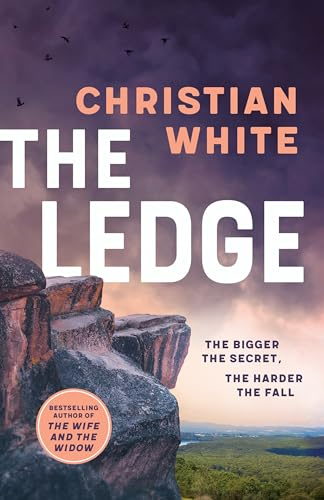
I always enjoy Christian White’s novels. He is known for his twisting crime mysteries and this one is no exception.
Human remains are found under a cliff which sends three friends into a tail spin of panic about what happened to their friend Aaron in 1999.
This one is a dual-narrative story which I always enjoy as I love reading about the past meeting the present. In this case it catches up to the friends who have a lot to hide.
The Ledge certainly delivers as we’re taken on a journey through Justin’s teenage diary and then see how his life as a mid-thirties man turns out. There is a lot at stake for the friends as the authorities close in on the mystery. To say more would give it away. But the twist is one you won’t see coming.
It’s fast-paced an well written and an ideal holiday read. Check it out.

It seems everyone is talking about and reading this book. It has courted controversy, admiration and much discussion.
Wifedom was one for our book group and created quite a discussion about George Orwell the man, the writer, and the husband. What Anna Funder does superbly in this book is to put the meaning of what it is to be wife, front and centre and in particular what was to be George Orwell’s wife.
Eileen O’Shaughnessy, herself an Oxford scholar and poet marries George Orwell and Funder meticulously explores her impact and influence on George Orwells’ work as an author, in particular of Animal Farm and the later works, 1984.
Having read both novels many years ago they made a significant impact on my younger self. Understanding the story behind the works now gives me the impetus to read them again.
Funder’s research takes us behind the scenes of this married couple’s life in Spain when Orwell fought in the Spanish Civil War, his writing and his battle with tuberculosis. More importantly she sees Eileen’s own struggle, to bring in an income to support them, her heath struggles and her utter devotion to doing everything to support her husband’s art.
It’s completely fascinating as Funder draws on the patriarchal system not just in the 1930’s but in current day of unacknowledged work done by women everywhere.
Orwell comes out poorly. His behaviour could be put down to the patriarchal system of the day yet Funder shows us that he was a very poor excuse for a human being.
I wasn’t sure about Funder’s imposition of her own story, while interesting, hardly added much. I did appreciate the incredible research to bring about such an enlightening story about a woman who was truly amazing in her own short life.
Read this one for yourself and you’ll get what all the fuss is about.
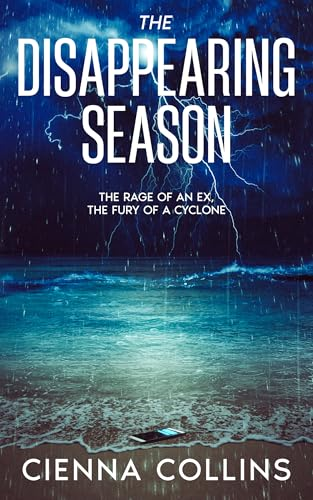
I’m only now just recovering enough to write a few words about this gripping and thrilling novel by Cienna Collins.
With the aid of her sister, Georgia Wright escapes the clutches of violent and controlling Andreas to Far North Queensland. There she manages to start a new life as a nanny to young Reilly whose father, kind-hearted Daniel has a few issues of his own. Together with housekeeper Margie the family quickly embraces her.
Georgia handles the dynamics of the household, a spiteful ex-wife and makes friends with Nayla. However, Andreas has other ideas about letting her go and when a full-scale cyclone looms things get very interesting.
Collins cleverly alternates the chapters with background snippets about Georgia’s life with Andreas and this creates a slow building tension from the beginning. Like Georgia, we the reader are never quite settled and relaxed with her new life. The relationships she builds with Daniel, Reilly and Margie are touching and engaging. Indeed, all the characters are well drawn. We are also privileged to be in Georgia’s head feeling every bit of her uncertainty and insecurity making sure we never entirely relax.
The description of the tropics is vivid and I felt like I was there or maybe since I was in chilly Melbourne, I just wished I was there.
“The day’s torrid heat is yet to kick in and lift the overnight rain from the shrubs, drops large and glassy on russet and emerald leaves.”
The second half of the book is a heart-racer when things quickly spiral out of control as Georgia’s races to survive in the middle of a violent and deadly tropical cyclone.
The writing is beautiful and this page-turner never lets you be. An excellent read and highly recommended.
Thank you to the publisher for an advance copy and I leave this honest review voluntarily.

I wasn’t quite sure what to make of this memoir about Flanagan’s family interspersed with their connection to war, Tasmania, colonialism and the birth of the atom bomb, but I liked it.
Flanagan takes us back in history to when his father was a POW arguing that if the atomic bomb hadn’t been dropped on Hiroshima he would never have been born.
It’s an interesting proposition as he takes us down the rabbit hole of the atom bomb’s invention due to an affair between the writer H G Wells with Rebecca West. Confused? He makes a compelling argument that Wells wrote a futuristic novel called The World Set free where he imagined the splitting of the atom, forecasting its impact as a weapon which would be used to kill hundreds of thousands. And that much is true.
Flanagan’s father was indeed a POW in Japan. However, on a visit there Flanagan found little acknowledgment of that fact in Japanese history. When the bomb was dropped on Hiroshima, the war ended allowing Flanagan senior to be released.
Interestingly there were a further series of events: physicist Leo Szilard discovered the nuclear chain reaction, a concept created because the man had read HG Wells’ novel The World Set Free.
Flanagan’s study of HG Wells’ writing correlates a link to the attempted genocide of Tasmanian aborigines, and of course we know the deep connection he has to Tasmania.
I loved the chain of events and was enthralled with the possibilities. I also deeply appreciated Flanagan’s own love and grief for his father. Indeed he’s the man today because of his family and also because he has faced his own mortality after nearly drowning when he was young. If you’ve read any of Flanagan’s books you will know he has mined his own experiences and that of his family often into fictional narrative. This book will be all the more richer if you have read any of his works.
Likewise, this book has so much in it, I don’t think it’s possible to absorb it all in one reading because the themes are deep and thought provoking. I wondered about my own interesting family history and it certainly gets you thinking about who you might be because of where you’ve come from.
Loved this one.
 S.C. Karakaltsas