Tag Archives: Goodreads

Book Review: Red, White and Royal Blue by Casey Mcquiston

I admit I selected this book because of its cover and from publicity generated by other book bloggers. Yep, I fell for the hype and there has been a lot. Had I read the blurb, I probably wouldn’t have bothered as romance is not a genre I read very often.  Nevertheless, I read this one. And I can’t say it was brilliant but it wasn’t all bad either.

The story centres around Alex, the son of a female US President and his relationship with a UK Prince called Henry. Does it sound like someone you might know? Initially, these two are enemies, then a friendship forms and eventually love grows with disastrous consequences. You get the drift.

It’s a light and easy read, although there are a lot of characters to keep up with. I found the sister and friend to be so similar that I kept losing who was who. I wonder why there really was a need for this extra character? The politics was interesting with the authors imagination running rife about the possibility of a female president. But the media craziness was as you expect. The character of Prince Henry was an interesting take although I could only visualise the real prince Harry whose name is actually Henry. Perhaps the names should have been completely different to avoid identifying with the real royal family.  

Of course, everyone is wealthy and beautiful and well, just awfully privileged. I just couldn’t get terribly invested in any of the characters. The biggest problems Henry and Alex had was keeping their scandalous secret from the media and not ruining an election. Predictable and not particularly compelling for me. But I gave it a go. If you like that sort of story then it’s one for sitting by the pool, I think.
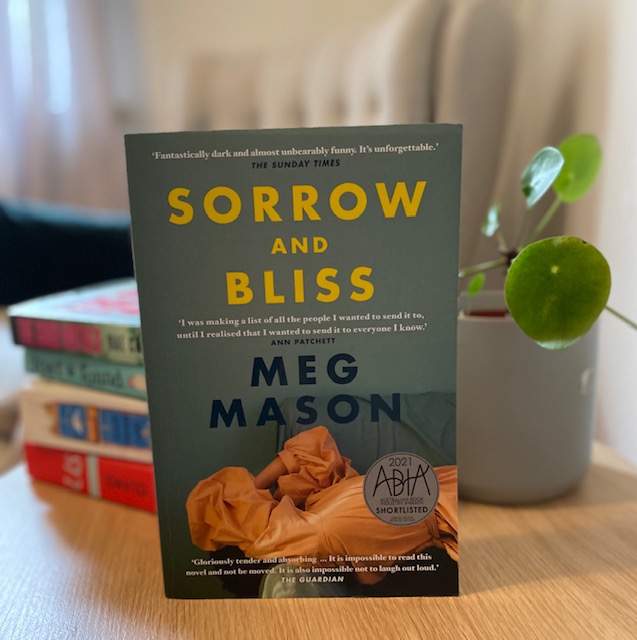
Book Review: Sorrow and Bliss by Meg Mason

Most of us have been touched by mental illness, either directly or indirectly by someone we know. This is a remarkably frank and honest story about a young woman called Martha who knows that something is not right but has no idea what it is and how to go about fixing it.

Martha comes from a family where her sculptor mother is barely there for her children preferring to leave her offspring to their own devices. Her father, a wannabe poet knows his daughter is not well and tries his best to help.

This novel is also about relationships and love too, especially between sisters. Martha’s sister Ingrid is her rock, her sounding board and her support. Ingrid is also quite a personality, all knowing and seeing when it comes to protecting Martha. The same can be said of the relationship between Martha’s mother and her aunt, Winsome. Indeed, it is Winsome, my most favourite character who holds the extended family together putting her arms around her own children as well as her nieces. Her love is intense and loyal. Winsome goes above and beyond including financing her own sister’s lifestyle. She even takes on Patrick, a young boy of fourteen whose own father can’t be bothered with him.  

Martha flits between relationships choosing the wrong men and learns much later how important Patrick is to her, unaware of his love until she is in her thirties.

The author deals with the illness in intricate detail, deliberately withholding from the reader the name of the condition, when it is finally diagnosed. The author does mention afterwards that the illness is fabricated and I’m not sure how people with genuine illnesses might react to that.  Nevertheless, it shines a light on how difficult mental illness can be and the problematic road to seeking the appropriate help which can be as daunting as it is difficult.

The author’s navigation around failing and blooming relationships is genuine and tender as is the discussion surrounding the pressure to have children for many women. Mason also spotlights the effects on loved ones who can feel helpless and lost in their support as shown by the toll on Ingrid and Patrick.

The writing is beautiful, flowing gently through the years of Martha’s life culminating in a hopeful ending.

I enjoyed this book but for some it might be hard to handle so much sadness. But there is a lot of light and shade with much love and humour that you can’t help be drawn into it.

Book Review: The Promise by Damon Galgut

The Promise won the Booker Prize for 2021 and like many winners this one doesn’t disappoint.

This is a story spanning four decades of the Swarts family in South Africa beginning with the death of Rachel, the mother of the three children. The youngest, thirteen-year-old Amor while grieving her mother, remembers a promise made by her father that their long serving maid, Salome would be gifted the house she lives in on the property.

The promise is never kept and the omniscient narrator takes the reader on a jaunt across many characters and history over four parts. Indeed, the historical events were illuminating, highlighting Mandela’s release, and the subsequent tumultuous political, economic and societal landscape.

It is probably one of the most unusual books I’ve read in a while. The narrator skips between character and setting sometimes in a paragraph, a sentence or in a page; sometimes into dreams and the supernatural. It did take a while for me to deal with this There are no chapters and this is a book where you need to read every line, every page. And in an effort to finish, I admit to trying to skip, but quickly realised the author demanded my full attention.

There are so many characters, some are relevant but many on the family’s periphery, represent the author’s razor-sharp observation of white South Africa, the white way of life, the political landscape, religion, capitalism, racism, reconciliation and apartheid. The disintegration of this dysfunctional family was interesting only because there was not a likeable member amongst them.

Indeed, Salome who we learn very little about appears to represent a hope for a way forward. Amor, largely impotent, pops in and out as a moral barometer reminding the family of the promise, while poor Salome sits in the wings waiting. Amor’s brother, Anton, paralysed by his traumatic experience in the army, is a man who struggles to do anything more than sponge off others. The sister, Astrid, also unlikeable, is spoilt yet suffers from problems we are given no clue about.

Yes, this is an unusual novel full of beautiful writing, yet sharply satirical, and humorous, almost slapstick in parts.

“The old minister is a large, soft man, with a sideways wave of crinkly brown hair. Much about him has a crumpled look, … And the skin on his hands and neck and face, all that’s visible of him, is loose and lined, and you really wouldn’t want to see the rest, under his clothes. ‘

I did enjoy this book although found the omniscient narrator style a trial at times. Yet, I can’t get it out of my head. It’s one that will resonate with me for some time.

Book Review: Infinite Splendours by Sophie Laguna

This novel is a heart-breaking and difficult one to read given the subject matter.

Set in the fifties, a mother lives alone with her two sons, Lawrence who is ten and Paul, eight. They live in a small Victorian town and Lawrence is a bright young student while Paul is sporty. When their long-lost uncle comes to visit, their mother brightens up and this stranger introduces vitality to their world. However, things change quickly when the uncle sexually abuses young Lawrence, changing his life forever.

Laguna takes us on a journey through Lawrence’s life which becomes crippled and stagnant following the abuse. He develops an horrific stutter and so is prevented from communicating into his adulthood. He is treated as mentally disabled because of the stutter and his withdrawal from his brother and everyone around him, sends no real alarm bells.

The only light for Lawrence is his artwork which becomes his lifeline as an isolated and shunned adult. He lives for it but he again is ostracised by everyone around him except for his brother Paul who is frustrated yet still cares and looks out for him.

Laguna’s writing is wonderful as always and I will always read anything she writes. However this novel is a tough read, uncomfortable and tragic. It’s not for everyone.

Book Review: Bodies of Light by Jennifer Down

I always like reading a Miles Franklin winner and this one recently won this prestigious prize.

The novel begins with the narrator opening a Facebook message from a man called Tony who is wondering if she is Maggie from his childhood foster home. The message leads Maggie to reflect on her old life and she takes us down a heart-breaking and tragic past. Her mother died from an overdose and her father was is in jail for murder by the time she reaches five. From then she is shunted from foster home to foster home, encountering abuse, drugs and institutional neglect.

This is a tough story to read and it makes you wonder how much trauma and tragedy a person can endure. For some, this will be a very difficult story to get through. Yet the writing compels you to keep reading, to turn the page with the desperate hope for something better for little Maggie. And whilst there is at times despair, there is also hope as she claws her way to people who do care and love her unconditionally. The scenes with her last foster mum are heart-warming and gratifying as is her early life with her husband and his family. But of course, nothing lasts for too long as events take a twist forcing her to make difficult choices.

The foster care system is fully scrutinised and its failings highlighted for debate in the wider community. Down shines a light on how institutionalisation affects a child’s, education, sense of belonging and self, demonstrated when Maggie finds she has no history – no photos, scant background on her family and little record of where she’s been.

Set in various parts of Melbourne and Phillip Island it’s always gratifying to read about my own backyard and the author has been meticulous in her research given that the time periods of which she writes have not been directly experienced by her.

It’s a fascinating novel, highlighting important themes, yet the last third for me seemed to drag a little. Perhaps the trauma of her life was just a little bit too much for me. However, I was compelled by Maggie, her resilience and her perseverance for the life she wanted and eventually got.

Book Review: Oh William by Elizabeth Strout

This was a surprisingly delightful read and I didn’t think it would compel me as much as it did.

The story centres around writer, Lucy Barton whose husband has died. She has two grown up daughters, and a first husband William whom she still has a connection too. When he invites her on a trip, she is puzzled by his need to be with her until a family secret is shared.

This is a journey of discovering William, dissecting Lucy’s relationship with him and their shared past. Lucy feels her invisibility and vulnerability as she reflects on her life, her successes and her failures.  What is really interesting is that we get to know Lucy Barton so well that the book ends with acknowledgements then continues with Lucy Barton’s book which is a memoir. It was confusing yet surprising as I wanted more which I definitely got.

Strout manages to pick out and analyse human frailty and faults in both characters to the point that we feel for them. William is lost when his relationship falls apart and it is almost sweet how he gravitates back to Lucy and one wonders if there is any chance of reconciliation. How Lucy deals with him is apt yet thoughtful despite the man’s appalling behaviour with women.

It is a very upper-class lifestyle where money is not a problem for these two successful people. Yet Lucy’s background of poverty makes her the person she is and the reveal about her is interesting. This is said to be a third novel in a series which I’ve not read yet it didn’t affect my experience.

Beautifully written, I can see why it’s made the Booker shortlist for 2022. The winner to be announced on 17 October. Watch out for it.

Book Review: Cold Enough for Snow by Jessica Au

Winner of The Novel Prize in 2021, this story is about a daughter and her mother’s holiday through Japan. They visit galleries and museums, eat at restaurants and generally act as tourists do.

This is a short novel of only ninety-nine pages and the narrative is filled with the daughter’s observations of art, or literature, her family or her mother. We get little sense of the mother’s thoughts or feelings and she comes across as reserved with little personality. Their relationship seems strained with a portrayal of detachment across a cultural divide.

The narrator makes the following observation to her mother. “Maybe it’s good, I said, to stop sometimes and reflect upon the things that have happened, maybe thinking about sadness can actually end up making you happy.”  Yet we are given nothing about the mother’s response which left me a little frustrated.

There is a lot of minute detail some of which leaves little to the imagination for the reader. This together with the ‘tell’ nature of the prose served to take me out of the story, giving me nothing to feel or even at times to care about the daughter or the mother.

Almost like a travelogue of observations and although nicely written, I found this one difficult to engage with. I’m glad it was a short one.