Monthly Archives: June 2015

How do you know if you can write?

keyboard

I had finished reading the book “Questions of Travel’.  The author, Michelle De Kretzer,  wrote two stories with two points of view. One was about a man who suffered the loss of his wife and son under horrific circumstances during the war in Sri Lanka and the other was the story of a wanderlust young woman.

Perhaps I could do the same thing but instead tell one story from two points of views. What I had was an important history in my fathers letters.Could I write a book about what happened on the island?

The Australian media focussed on the murders of the husband and barely mentioned his wife. I know it was indicative of the times but this got under my skin. I wanted her to have a voice. Why had they died? What had happened?

One night I lay in bed and thought about what she must have endured . I couldn’t sleep so  I got up and wrote my first chapter.

I hadn’t written anything creative since high school. I had worked in the financial services industry for more than 30 years. What did I know about writing? I hadn’t written anything . . .  or had I. I began thinking about my working life. I had written policy, procedure, letters, emails, newsletters, speeches,templates. Perhaps I was equipped to write but didn’t have the confidence. What I did have though, was my growing obsession which drove me to just give it a go. What did I have to lose? I read that first chapter to my family and with their encouragement began to build confidence.

I went away for a weekend with some close friends and read  the first chapter. I got some positive feedback – wow. A small part of me wondered if they were humouring me . . .  or if they were just shocked to find out I wanted to write a book . . .  or maybe just surprised I could string two words together.

It was enough to spur me on to write five chapters. I picked out the events that my father wrote about then visualised the scenes with the help of the photos I had.The story was built  around the events and I  filled in the missing blanks. How did I do this? Research and imagination.

How did I know if I could write? Well, I still don’t but if it makes sense and the reader gets something out of it then I’m half way there. Aren’t I?

How My Obsession Began.

I had almost finished typing up the letters.

The next one dated 3 May 1949 dropped a bombshell. The gruesome murder of a couple – I knew their names. My father had mentioned them in his earlier letters. Why had this  Australian husband and wife been stabbed to death? I didn’t know them but my father had a connection to them. I don’t know why, but I felt sad. Was I the only one who thought about them after 65 years?

I flipped through the remaining letters – there were only 3. The murderer was at large and three detectives from Brisbane  arrived. The next letter speculated about the murderer. “By the way, you seemed to think that natives were the cause of this strife – well they’re not. They would never come at anything in that nature and so far as I’m concerned the Chinese aren’t a patch on them so far as work and manners is concerned.”  Did he believe someone from the Chinese community was the culprit?

The final correspondence ended by saying that a person had been arrested.Then nothing more.

Imagine my frustration. I had lots of questions  and my father was no longer here to ask him. Then, when I thought about it, I realised he probably didn’t know much anyway.

I had typed up 65 pages and 23000 words – a story had unfolded.  All I had to do was work out how to tease these events into a coherent story. That’s when I started writing my  novel and my obsession.

When do you tell a white lie?

My father had an operation on his appendix. The doctor and his boss each wrote to my grandparents to tell them and to also let them know that he was well.

He had always been fiercely independent and he played it down in his letter.’I’m very sorry about his appendix business Mum. The doc didn’t tell me anything about sending that cable, and I told you a fib in the letter so as not to worry you.’ I wonder what my grandmother must have thought. He had been away three months on this remote island and already two trips to hospital!

To prove how well he was and I suppose to allay any worries  he later writes,
“I’m thriving on the life up here though and reckon it’s a great place. I’m as fit as a fiddle – developing quite a few long unused muscles owing to the strenuous work and still eating like a horse.” He painted a picture of  his social life – playing tennis, dinner parties and dances.

I knew from his letters there were about 2000 workers on the Island, some with families, but for the most part, the population was male. I started imagining what it must have been like. No doubt there would have been alcohol and I wondered if a young man like him would have indulged. It was a rare day when he didn’t enjoy a beer in his adult life and he was proud to tell us that he never drank to excess.

I wondered if it had started on Ocean Island. I smiled when I read a line in one of his letters.
  ‘And I hope you’re not worrying about the manner of my liquid refreshments – the strongest drink I’ve had, or intend to have is fruit cordial, but put away an average of about four or five coconuts per day.’

I found out later that the European workers each had a daily beer ration. I learnt to read between the lines.

How exactly do I find out more?

State Library of Victoria

State Library of Victoria

So  I knew a bit  about Ocean Island. But if I really wanted to understand what my father had experienced, I would have to read something of that time. Luckily he’d mentioned reading  the “Mid-Pacific Outposts” which had been written in 1945 by  Albert Ellis himself (see my earlier post entitled ‘ Where is Ocean Island?’ for more on him).

Surely my father had kept a copy – I searched through all of his old boxes – nothing  but old school trigonometry books – why on earth had he kept these?

I searched the internet and found it listed but not in stock. I searched bookshops for old and rare books – nothing.

Then I discovered Trove which is the brainchild of the National Library of Australia. What a site! I found articles, newspapers, books, letters, archived for viewing in many cases on-line, dating back to the 1800’s – and mostly for free. It listed the book available in my own State library. The only catch was I would have to go there – it wasn’t available to borrow.

I admit that I’d never been to this amazing place in the centre of Melbourne. Once there, I ordered the book and waited for half an hour while they brought it down from some secret spot in the bowels of the library. I  explored –  there were terminals, a newspaper room, communal desks, people everywhere and books, books and books. It was a busy place. I must have looked like a country hick – mouth open in awe. In truth, I  live only a short distance away in suburbia.

Soon my book, labled with my name, was ready. It  looked and smelt like it’d been in a dark dusty dungeon. I  found a place at a communal table and opened the cover.The last time it had been taken out of its dingy hiding spot was in the fifties – a popular book, it wasn’t.

After ten minutes of reading, I was only up to page 15 – this was going to be slow.  My Ipad was in my bag – so I took photos of the pages I wanted. I glanced around but no-one bothered me or seemed the least bit concerned.

There was great information but if Mr Ellis were relying on reviews of his book today, I’m sure the feedback would not be good.

The internet has been an amazing source of information  and it continually astounds me. But there was stuff in this book that I would never have found on the internet and there are still holes in our information highway waiting to be filled.

Where is Ocean Island?

pacificislands

I began telling friends about my project. I was surprised they were interested – they wanted to know more.

“Where is Ocean Island?”
“In the middle of the Pacific,” I happily answered. But that meant nothing to anyone.
“You know, Nauru?” I said.
“Yes.”
Everyone knows about Nauru but only because of the emotional and raging debate against Australia using it to house asylum seekers.

“Well, it’s near there. About a hundred or so kilometres to the east,” I said confidentally.But I knew very little else.

I thought I’d better find out a bit more and the internet enlightened and surprised me.

I read one reference from a fellow to the question, ‘where is Ocean Island’ and he replied, “All over Australia mate.” What did he mean? I soon found out.

In the early 1900’s, Nauru had been in the hands of the Germans who mined phosphate. Albert Ellis, a young New Zealander discovered that there was tons of phosphate on nearby Ocean Island and placed a stake on behalf of the British. He negotiated with the island chiefs and paid them fifty pound a year and promised to bring in water. The islanders or Banabans ( as they were known)  thought it was a great deal considering that most of their number had been wiped out from the last long drought some years before. So at the turn of the century, mining commenced and didn’t stop until the phosphate was virtually gone in 1979. During that time, Australia managed Nauru and Ocean Island jointly with New Zealand and Britain. When the First World War broke out, the British secured Nauru from the Germans and the Australians mined it too.

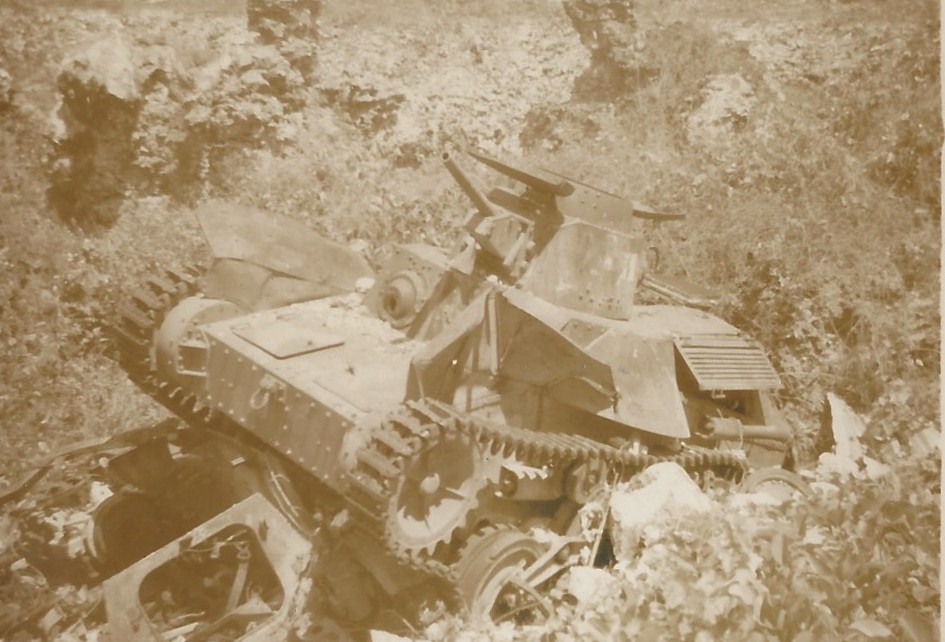
However,during the Second World War the Australians abandoned both islands when the Japanese advanced and occupied most of the Central  pacific region. The islanders were treated harshly and most of the Banabans were dispersed across the other nearby islands. Food was scarce and death was the norm at the hands of the Japanese. My father must have been touched by the site of old Japanese tanks left abandoned around the island. This is a photo he took in 1948.

Abandoned Japanese Tank left on Ocean Island ( Banaba)

Abandoned Japanese Tank left on Ocean Island ( Banaba)

Today, Banaba as it is now known, belongs to Kirabati, one of the poorest nations on earth. You can just make out the speck called Banaba near Nauru on the map above. Now largely abandoned with an ecological disaster on their hands, a small number of native Banabans try to eek out a living.  The rest of their people live on Rabi, an island bought for their relocation in 1945 – some hundreds of kilometres away in Fiji.

So what is phosphate used for? It was mined and brought back by ship and used primarily by our farmers as fertiliser.

My curiosity and excitement about this island was growing. I was drawn to the place and its history and the experience my father had in the twelve months he was there. In the back of my mind, the threads of a story was brewing.

I wasn’t a writer I told myself. I didn’t know what I was going to do or how this project was going to unfold, but I knew I had to push on.