Author Archives: S.C. Karakaltsas

Unknown's avatar

About S.C. Karakaltsas

I am a published author of historical fiction and short stories.

My Book is Actually Published.

It was quite accidental really. After uploading my book into Createspace umpteen times, fixing format, spell checking and staring at the same errors over and over, I finally pressed the approve button.

Then the message popped up, “Congratulations. You are now published.”  Oops! I hadn’t meant for it to be out there so soon.

You see I ‘d decided to present my book at a formal book launch with supportive friends and family, but somehow it made its own way to the  Amazon book store. Then  within a few days the book was purchased not by one but three customers. I was very nervous as well as excited. Of course, the launch is still being readied.

I just can’t quite believe it, but now I’m a published author.

But a word of warning – go back and check the instructions before you press that approval button.

If you’re curious, feel free to check  out my novel “Climbing the Coconut Tree”  at the link below.

The Proof is in the Hand

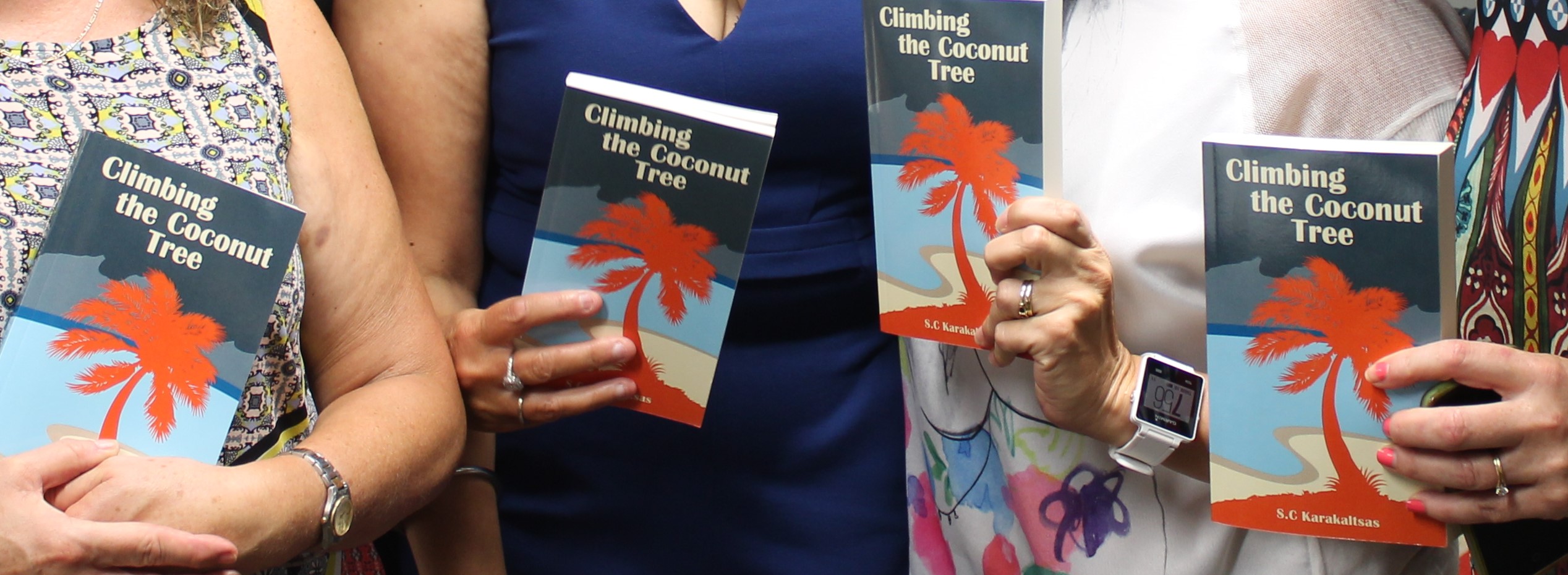
 Proof pic

I uploaded my  manuscript into Createspace and waited for the file to be checked. Approval came through and I was invited to peruse the finished book on-line. It looked like a book, but for me, I needed to touch and feel it.  So I ordered three proof copies; one for me and two, for others to proof read.

A few days later, the door bell rang and there was the courier holding a small box in his hand. I took it and walked around the house with it. I knew what was inside, yet all I could do was stare at the package.

Finally, I peeled off the wrapping and found a real live book –  a manuscript no more. Like a newborn baby, I was tentative about picking it up. I was excited yet nervous. Months of work and obsession sat there waiting for my scrutiny. I made myself a cup of tea glancing into the open box, I guess to make sure the book was real. Then, with my cuppa, I picked it up and sat down to read.

About twenty percent of book sales are eBooks but there really is nothing like holding a paperback in your hands – flicking the pages back and forward, turning it over to read the back, examining the feel of the cover and pages inside.

Unsurprisingly I found myself making changes once again. Was I ever going to stop I wondered?

What’s in a Cover

How your book is dressed entices the reader to look inside. Never judge a book by it’s cover? Rubbish! We all know that’s simply not true. It’s the greatest marketing tool to have. So how do you decide what the cover should look like? It’s a big question and a hard one to answer.

My book is historical fiction so I knew that I wanted a vintage feel. My book is titled “Climbing the Coconut Tree” so a coconut tree might be a good idea somewhere on the front. I had a working cover photo of an original ink picture that someone had drawn by hand of a coconut tree and native huts. It was on a Christmas card sent by my father in 1948. I was never able to find out who the original artist was. It is beautifully drawn in black and white and I although loved it, I knew it wasn’t strong enough.

Original front cover

Strolling across the internet there are lots of economical do-it-yourself covers. Createspace and Smashwords provide templates. But the problem for me was there was nothing that really grabbed me. Finally, I decided to seek help and found a graphic designer Anthony Guardabascio from http://www.continue.com.au. He designed my perfect cover which is below. I really love it and I hope you do to.

Print


In the gutter.

When it comes to getting your book out into the marketplace,  big decisions are needed.

I’d tried traditional publishers but in big business an unknown and untried author is rarely noticed. I wasn’t daunted though because I wanted to stretch myself further by exploring the options of self-publishing.

I had a manuscript. It was edited, reworked and revised. I went to workshops on self-publishing. There’s a carnival of sites like Ingram Sparks, Createspace and Smashwords amongst many who make it sound easy. After all what could go wrong. Just sign up, build your cover and upload. Easy. Nothing to it.I knew some people who had done it. A couple were in their eighties. Surely it couldn’t be that hard.

I was wrong.

There was another step in the process that I hadn’t counted on and it was called formatting. How naïve I was?

I tried a recommended site called Pressbooks which is a WordPress format. The deal is that you copy and paste your book and they take care of the format. For a small fee they do the formatting for print and ebooks in one foul swoop. Somehow it didn’t work quite that way for me. There was so much extra work for me to do with them that I decided to format it all myself. Was I brave or just stupid?

Nevertheless, I took the leap. I spent weeks learning how to format my lovely manuscript. I learnt about gutters (that’s the bit in the centre of two pages in a book) and how they need to be a certain width. Who’d have thought  this was so important and that I would find myself falling into it, so to speak.

I learnt about indentation, paragraph spacing, font, sizing, page numbers, front matter and back matter. There’s lot to it. Making lots of mistakes along the way and seeking help from Robert, a fellow writer, improved my expertise enormously.

And of course, formatting a print book is very different to an ebook.

But a basic crash course in Word would have been very helpful at the start.


My Adventure into Social Media

mazeApparently I needed an online presence to get my book out to a wider audience. Easier said than done!

I had no presence. Online, that is. I typed my name into the internet browser and found that there was absolutely nothing about me. It all seemed scary… but then the unknown often is.

Is this what people felt when Galileo declared that the world wasn’t actually flat? If I take the leap will I fall off the edge of the world wide web?

Like a modern day explorer, I set out off into the maze. I joined Facebook, Instagram and Twitter. That seemed easy.

Now for a webpage. I heard about WordPress. It seemed straightforward, but it was a minefield of inhospitable terminology. Well, for me anyway. For goodness sake -what on earth is a widget? I got as far as I could on my own and then got stuck. I sought help and luckily, my friend’s son, Theodore knew all about it. After a few pointers I got back on track.

It was exciting to set up my page. Like decorating a new house, I chose colours, pictures and themes. Now what?

I had to write something. What was I going to say? I looked at what other writers were doing. Some were writing about their daily lives. Some wrote stories; others wrote poetry. In fact, people seemed to write just about anything.

Finally, I typed my first post. My finger hovered over the publish button. I moved my hand away. Once I published where would it go? I was invited to make it sticky. What did that mean? Uncertainty and fear plagued me. Like Scarlett O’Hara, in Gone with the Wind, I too decided to think about it tomorrow.  I kept my first draft for a day or two or three.

After a week or so of procrastination, I took a deep breath and  pressed the publish button. Then waited and waited. Nothing. Funnily enough, I was relieved – there was no expectation, no feedback and it didn’t come crashing down all around me.

No news was good news as far as I was concerned so I decided give it another go. My next post was published. I got some likes and then some followers. Then I posted again and again.

It seems so long now since that first post but if you haven’t read it here it is… https://sckarakaltsas.wordpress.com/2015/05/19/the-letters/


The Publishing Merry-go-Round

I had restructured, edited and rewritten my whole book. Spent nights and days thinking about nothing else.

It was time to send it out to traditional publishers.

I researched how to write a pitch or query letter. There are plenty of great ones on line.  I carefully read the submission requirements for each publisher. I tested the waters and sent the first three chapters off to three or four publishers.  Then sent another three or four and so on. So then the waiting began. Most tell you that if they want to read more they’ll get back to you. You may never hear back and, if three months has passed then you know that you will never get a response. That’s just the way it is. It’s nothing personal – it’s just business.

One afternoon I received a phone call from Adam. He rang to let me know that my submission had been received- a nice touch instead of the obligatory email, I thought. He had read my query letter and asked me a few questions about the book. Like a job interview, I answered his questions and well, perhaps earbashed him with my enthusiastic response. He told me that he would refer it to the team for them to read. I hung up the phone in disbelief and excitement. But I think, in truth, I was feeling anxious. Was I truly ready for someone else to read my work? Did I want to hand over my baby to others?

A month later, I received some rejection letters from other big name publishers. Thanks but it’s not what we’re looking for … and so on. It was as I expected.

Then Adam called. “We’re interested,” he said, “but we need to get an evaluation report externally to determine the books saleability. We might need to change the title or structure.” He went on to say that I would need to make an investment to meet the cost of the evaluation feedback. Warning bells rang in my head. Traditional publishers never ask for money. Was Adam a vanity publisher? That is, one who’ll publish your book for a substantial fee. His web page indicated otherwise.

It was my turn to interview him. My years in business enabled me to get some answers. And I wasn’t very satisfied. The whole reason why a traditional publisher is sought after, is for their distribution network. They can get your books into book stores. Yet Adam’s distribution network was very small and mostly in schools. Then, I heard a podcast, warning writers about unscrupulous publishers stinging writers for tens of thousands of dollars. Adam’s company was one of them. I realised that he was not the publisher for me. Which is why it’s so important to research publishers.

It is indeed a hard slog for writers to get a book published by a traditional publisher. It is after all a business for book sellers, distributors, agents and publishers who together must make a living – often taking 90-95% of the takings from a book sale. The author gets the rest.

It was time for me to take stock and consider my options.

****