Tag Archives: Reading

Book Review: The Fortunate Pilgrim by Mario Puzo

It feels good to go back in time and read a classic. I read The Godfather by Mario Puzo many years ago and indeed it is a classic. The Fortunate Pilgrim, written before The Godfather and published in 1965 is no less so. But unlike The Godfather, The Last Don and many of Puzo’s legendary novels centred around men, this book is about an uneducated, peasant woman, Lucia Santa, plonked into New York’s Hell’s Kitchen from Italy.

It is said that Lucia Santa is Puzo’s mother and what a woman she must have been. Her life as you can expect, is not easy with six children, one dead husband and another husband with mental illness. Lucia Santa, has the strength of several men, ruling her family with an iron fist through the Depression and War. Like so many women past and present around the world, she can’t afford to succumb to self-pity and has no choice than to work hard to protect and nurture her brood in order to survive.

Puzo captures summer in New York in the Tenements with the community of Italian women whose lives were governed by poverty yet pioneers in their own right. … ‘they moved in a sadder wilderness, where the language was strange, where their children became members of a different race.’

The language is almost poetic as we are introduced to Lucia’s seventeen-year-old son Lorenzo, riding his black horse through the streets of New York in 1928. One by one, Puzo allows us into the lives of the older children, giving tantalising glimpses of other families on the street and takes us on a journey of struggle, despair, and joy until the second World War.

The characters are well drawn and we learn of the petty small mindedness of the community in which Lucia Santa lives. ‘What cronies they were. How they ran to each other’s apartments, up and down the stairs, into the adjoining tenements… taste this special dish. After the initial pity and condolences, the true face of the world showed itself to Lucia Santa.’

The writing is inspirational and is truly a wonderful chronical of a matriarch and the immigrant’s life.

Book Review : Eleanor Oliphant is Completely Fine by Gail Honeyman


I’d heard about this book and closed the final page last night. It did not disappoint. What began as a slow boil exploded in the last quarter of the book and I was unable to put it down.

Eleanor is a thirty-year-old woman who lives on the fringe of society. She is a creature of habit, working at an office during the week, doing cross words, eating pizza and drinking vodka on the weekend by herself in her tiny flat. She cocoons herself away and you know there is something not quite right. She’s never known the warm touch of love and wonders what it might be like. Her observations of the world around her are comical, sad and poignant. What social interactions she has, is extremely awkward and naïve until she meets Raymond who works at the same company and takes the time to try to understand her.

To reveal too much would spoil it, but this novel is a study on loneliness and isolation which we often associate with the elderly, not someone of this age. Eleanor’s awkwardness and naiveté makes for some very funny moments. If you think the story sounds a bit morbid, it isn’t. Eleanor is a survivor and to watch her grow is glorious. The author cleverly hints about her childhood and builds on it until the explosive reveal toward the end, when we discover why Eleanor is the way she is.

It’s memorable and heart-warming. I really enjoyed it.

Book Review: Lincoln in the Bardo by George Saunders

Every so often a book comes along to shake up storytelling. This seems to be one such book.

The premise is relatively simple. Set in a cemetery at night, a grieving Abraham Lincoln visits his eleven-year-old dead son who is caught in a nasty and unpleasant realm called a Bardo.

Ghosts, who for some reason think they’re not dead, roam freely around the cemetery. This was a bit of a stretch, but then, this is the fantasy part. The reader is bombarded with a cacophony of ghostly characters (said to be more than 150) each voicing their thoughts and anguish as lost spirits caught in between worlds. The reason is not altogether apparent to them (or the reader), but it seems they’ve done something bad somewhere in their lives. Most of the narration is dominated by three men and female spirits are few. Perhaps, I like to think, they are generally good souls who have gone straight to the afterlife, while the rest are not.

I’d heard about this Booker Prize winning novel and thought the premise had merit. Not being terribly familiar with American history of the Civil War, I expected to learn a lot. From the first few pages, I became hopelessly confused with the one or two-line dialogue per character. I read a review which explained the book and then I re-read the beginning again. Maybe it’s me, but should I be confused about what’s happening and have to resort to someone else to explain?

Other sections of the book were excerpts from essays, books or newspapers of the time. This was interesting and clever of Saunders as it gave an insight of how history is interpreted depending on what side you’re on.

There’s not much of a plot or development of characters and none that you really warm to. Although I did feel something for Willie Lincoln, the son. But I guess this was not the intention, after all, this is not a book like any other. The reader must work at it and read carefully even when some parts make no sense or may seem superfluous. I confess to skimming sections yet being thoroughly absorbed in other parts.

The writing is good and reads almost like a play, poetry and encyclopaedia all rolled into one. There’s humour, amazement, frustration and boredom. The reader is provoked and prodded but I’ll admit, I almost gave up.

Yes, it’s not like any other book I’ve read before. I know this book is acclaimed and lauded by many others who loved it. Did I enjoy it? I can’t say I did. It was adequate enough for me to have finished it. Maybe I should re-read it again. It probably warrants it. But there are too many other books more worthy of my time. A word of advice – try and read it in one sitting. I think it might work better than a few pages a day.

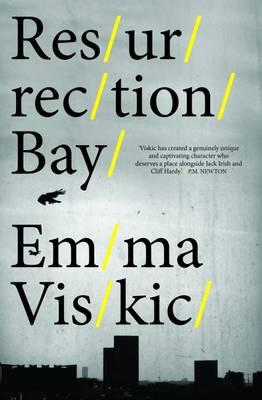
Book Review: Resurrection Bay by Emma Viskic

I’d heard about this book and the author, and when I saw it the other day, I just had to buy it. And no, it’s not on my list for 2018.

It’s another crime novel for me, (remember I only started reading this genre a few months ago) set in a fictitious town in coastal Victoria, Australia. I’m really getting into some truly wonderful stories. Resurrection Bay is no exception.

Caleb Zelic is a deaf man whose insights into people’s behaviour allow him to pick up clues when on the hunt for the killer of his childhood friend. As a private security investigator he works with his partner, ex-cop Frankie who has her own demons. All they have is the text message to Caleb from his dying friend. Caleb uses lip reading and facial expressions to communicate and is a master with body language. But he fails to see what’s going on behind his back as he stumbles headlong into danger. Along the way, he learns unpleasant truths not just about the people around him but himself as well.

From the first paragraph to the last, I was gripped by the authors writing. It’s fast paced and I found I had to slow down my reading to keep up with the many minor characters in the story. I loved the main characters particularly Caleb who refuses to allow his deafness to dominate his life. This is handled extremely well and gave a lot of insight into how deaf people deal with their environment.  There’s  a lot to like about Caleb and his vulnerability. I  found myself flinching as I almost yelled out loud telling him to watch out. Luckily, I was in the privacy of my own lounge room.

No wonder it’s won lots of awards. It’s well written and a quick and easy read. Give it a go. I’m sure you won’t be disappointed.

Book Review: Skylarking by Kate Mildenhall

Kate and Harriet are best friends who grow up on an isolated cape in the 1880’s where their fathers are the lighthouse keepers. They do everything together and as they grow into young women their lives are disrupted by the arrival of a man, McPhail. A moment in his cabin changes their lives forever.

The author, picked over the bones of a true story and imagined the lives of the girls. From the first line and last lines in the prologue, the reader is propelled head-long toward the climax.

“The sky was clear and blue forever that day.”

“I remember the way Harriet turned, breathless, laughing, a strand of her golden hair caught on her bottom lip. After that, I try not to remember.”

We are dropped into the stunning wilderness of the cape near Jervis Bay, NSW, and into the lives of the families. We are privy to everything about the girl’s friendship, their deep love for each other and the expectation of them as young women in that era. Loyalties are tested and risks taken as we are led to the edge of the cliff and back again.

The writing is beautiful and evocative; the cover stunning. This is a wonderful Australian debut novel by Kate Mildenhall.

Book Review: The Lost Pages by Marija Pericic

Marija Pericic won the Vogel Prize for this stunning debut novel set in Prague in 1908. Pericic reimagines the relationship between literary giants, Max Brod and Franz Kafka.

Knowing little about either novelist, I was quickly drawn into a story full of anguish, tension and human fragility. The author veered away from the known story that Brod was asked by his friend Kafka, on his death bed to destroy all of his unpublished work. Instead, Brod publishes it making sure that posthumously, Kafka is revered and honoured into the future.

What happens though, if history is rewritten? What if Brod, a tortured man with physical disabilities is filled with self-doubt and actually loathes Kafka as his rival? What if Brod falls in love with a girl who loves Kafka? It makes for a compelling read. Does it matter that the work is fiction? It’s an interesting take on historical figures. Events are true but the rest is not.

The writing and development of characters was exquisite as we are taken into Brod’s point of view. His disability is a key theme “The tongues of those who inhabited my world were silent, but their eyes were not. Their eyes spoke, that sea of eyes through which I moved each day. They glanced and looked in secret and averted their gazes, and this looking and not-looking spoke louder than any voice of disgust, curiosity or, worst of all, pity.”

Life in Prague in the early 1900’s is rich with description and mood which changes with the deterioration of Brod’s mind. The twist at the end caught me by surprise leaving me yearning for more.

My Reading List for 2018

In my last post I listed the books I read for 2017 and chose my Book of the Year. https://sckarakaltsas.wordpress.com/2018/01/01/books-of-the-year-2017/

It’s time to start compiling the books I want to read in 2018. Some in my list are ones voted on by my book group, some I’ve heard about and others are recommendations.

Let’s see how many I actually get through.

Here goes -:
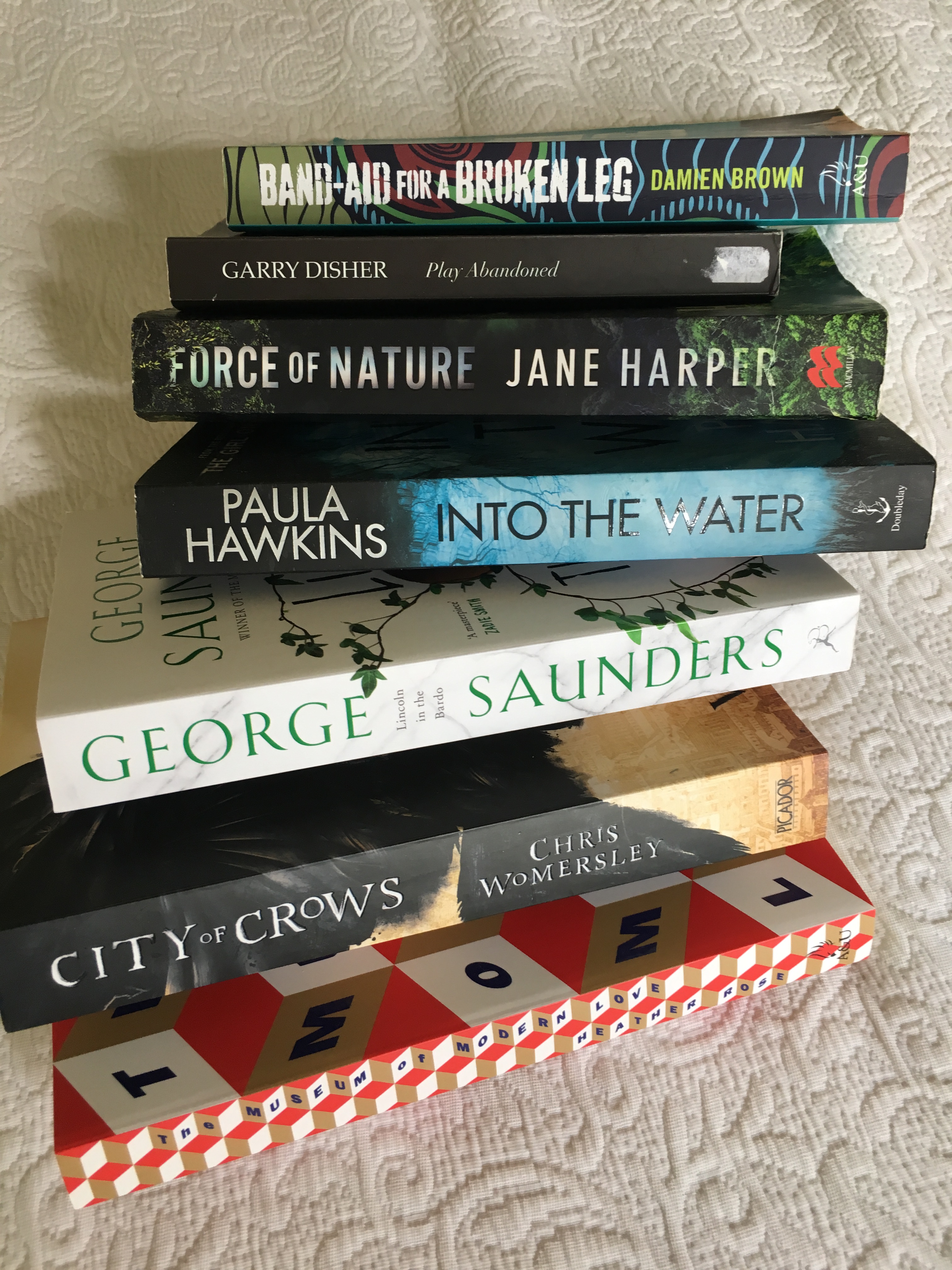
1. Lincoln in the Bardo by George Saunders
2. Into the Water by Paula Hawkins
3. A Gentleman in Moscow by Amor Towles
4. Never Let Me Go by Kazuo Ishiguro
5. The Sympathizer by Viet Thanh Nguyen
6. Little Fires Everywhere by Celeste Ng
7. The Choke by Sophie Laguna
8. Force of Nature by Jane Harper
9. City of Crows by Chris Womersely
10. Our Souls of the Night by Kent Haruf
11. The Museum of Modern Love by Heather Rose
12. Band-aid for a Broken Leg by Damien Brown
13. Skylarking by Kate Mildenhall
14. Conspiracy of Lies by Kathryn Gauci
15. The Horsemen by Tim Pear
16. The Lost Pages by Marija Pericic
17. Fever Dream by Samanta Schweblin
18. Play Abandoned by Garry Disher
19. The Hate U Give by Angie Thomas
20. Eleanor Oliphant is Completely Fine by Gail Honeymoon

No doubt there will a few new releases thrown into the mix as well. If you have any recommendations, I’d love to hear about them.