Tag Archives: Reading

Book of the Year: 2017

I decided at the beginning of the year to  keep track of what I read and have surprised myself with the list. I know for some readers, twenty seven books is not that many, just over 2 per month.  I guess that’s not too bad especially since I haven’t included all the books and papers I’ve read as research for the current book I’m writing.  Interestingly, my list contains 18 books by women, of which 12 happen to be Australian. My selection is skewed to Australian writers, there are 17 on the list which makes me think I should widen my choices. But there are just so many good Australian authors and if you’ve never tried one, then you should.  I’ve completed reviews on half and hope to continue this into 2018 as I become more diligent with my reading.

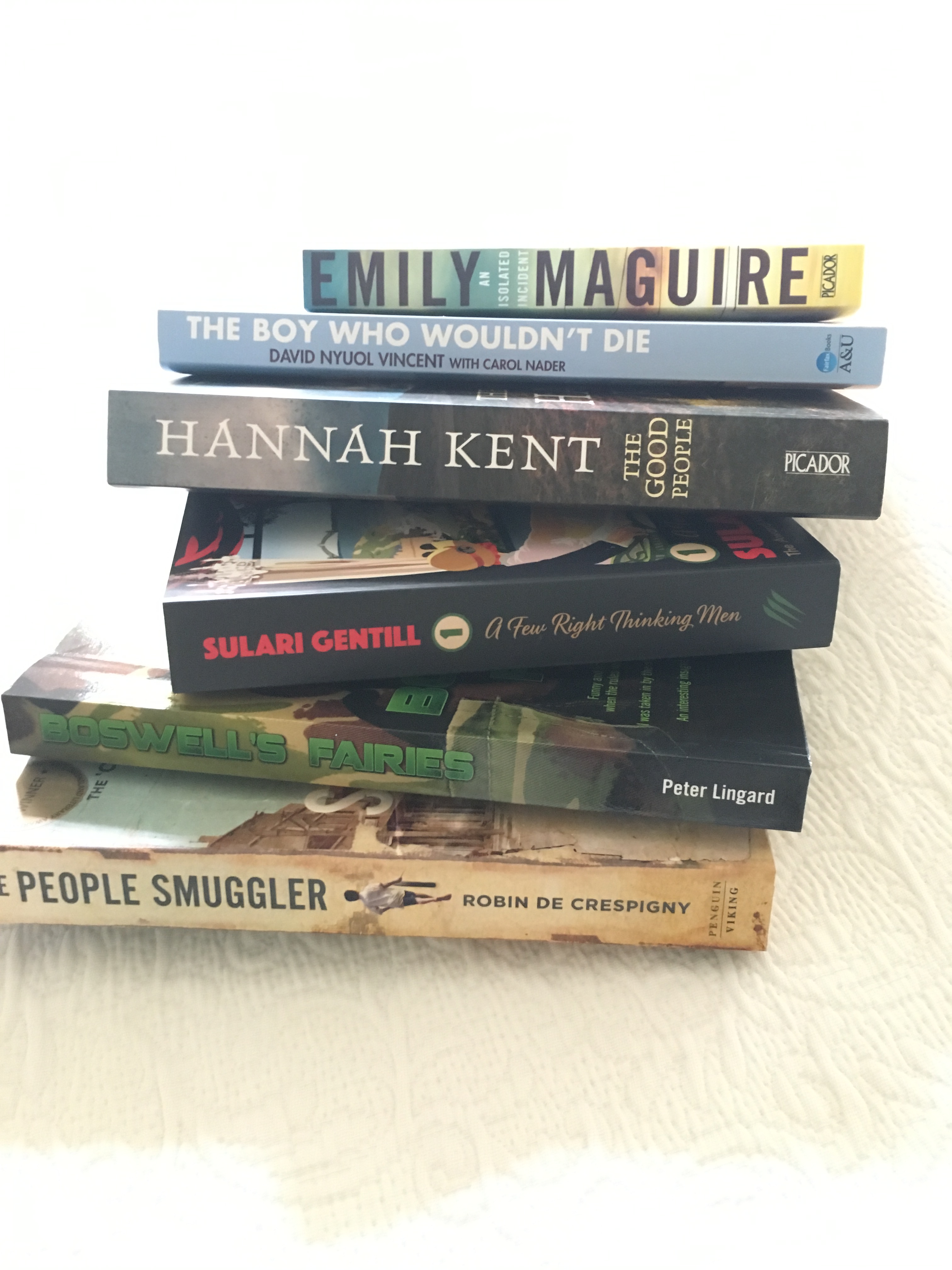
Here is the list for 2017.  I wonder how it compare to yours.
1. Beauty is a Wound by Eka Kurniawan *
2. Talking to My Country by Stan Grant
3. The Invention of Wings by Sue Monk Kidd
4. The Boy Who Wouldn’t Die by David Nyuol Vincent
5. By Grand Central Station I Sat Down and Wept by Elizabeth Smart *
6. A Shadow’s Breath by Nicole Hayes
7. The Good People by Hannah Kent
8. The Embroider by Kathryn Gauci
9. The Sciences of Appearances by Jacinta O’Halloran
10. The Mermaid Chair by Sue Monk Kidd
11. Eileen by Ottessa Moshefgh *
12. The People Smuggler by Robin De Crespigny
13. Reckoning by Magda Szubanski
14. North Water by Ian McGuire *
15. Everything to Live For by Turia Pitt
16. The Mandibles by Lionel Shriver *
17. The Last Days of Ava Langdon by Mark O’Flynn
18. Beauty in Thorns by Kate Forsyth
19. The Heat by Garry Disher
20. A Few Right Thinking Men by Sulari Gentill
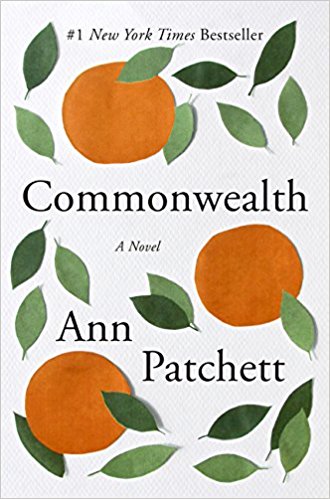
21. Commonwealth by Ann Patchett
22. Boswell’s Fairies by Peter Lingard
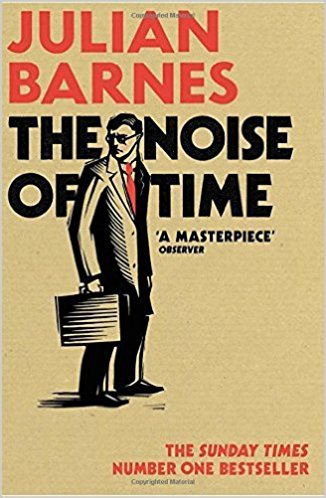
23. The Noise of Time by Julian Barnes *
24. The Lakehouse by Kate Morton
25. An Isolated Incident by Emily Maguire
26. The Dry by Jane Harper
27. The High Mountains of Portugal by Yann Martel *

My top picks for 2017 are highlighted in bold. The ones with an * are my least favourite and as for the rest, I’d recommend each and every one of them. But I have to pick my book of the year, and it is pretty hard as it’s very close. But my choice would have to be  The Good People by Hannah Kent. Beautifully written, it’s a haunting story of three women in rural Ireland in the 19th Century.

On to 2018. Happy New Year everyone.
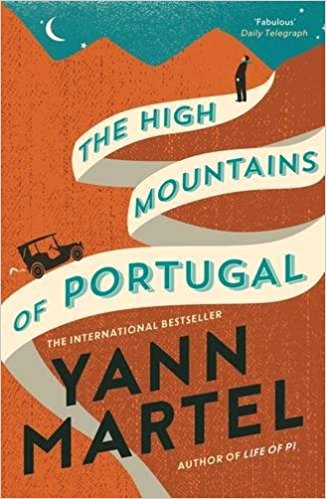
 

Book Review: The High Mountains of Portugal by Yann Martel

I loved Martel’s Booker Prize Winner, Life of Pi and was keen to read The High Mountains of Portugal. This is not so much a novel but three separate stories spanning a century. It begins in 1904 when a young man, Tomas goes in search of an artefact which he believes will jeopardise Christianity. Using the strange mode of transport for its time, the motor car, Martel takes us on an interesting journey. Thirty-five years later a Portuguese pathologist devoted to Agatha Christie murder mysteries finds himself in his own murder mystery. Fifty years on, a grieving Canadian goes to a village in Portugal with a chimpanzee and Tomas’s initial quest is brought full circle.

Part fable and fantasy Martel takes us on an almost spiritual journey. The detail is sometimes laborious and at other times fascinating. Try to imagine getting into a vehicle for the first time when there was none around and navigating it in first gear through gawking villagers who’ve never seen a car before. I laughed when Tomas parked the car under a tree. Later he realises that he did not know how to reverse the car and instead chopped the tree down only to be faced with a stump which he could not drive over. However, the journey, at times, becomes all most as tedious as a real life one. I found myself skipping some repetitive sections to get to the point. The second story meandered. Although the third was better.

It’s not a fast paced read and it has little in plot. Yet the themes of love and loss are delicately weaved into what is sometimes absurd surrealism. Martel writes beautifully and plays with style and ideas, but I’m afraid this wasn’t quite enough for me.

Book Review: The Dry by Jane Harper


Aaron Falk, a Federal police officer returns to his hometown in country Victoria to attend the funeral of his former childhood friend Luke, who murdered his wife and son then turned the gun on himself. Behind the scenes, lies the twenty-year-old history of the death of a teenage girl which still  haunts Aaron and the town. Luke’s grieving parents, plead with Aaron to investigate what they can’t accept as a murder-suicide and together with a local policeman, he unwinds more than he bargains for.

The tone of the novel is pure Australian small town and the author does a wonderful job of pulling us right into the pace never letting us go. It gets into your head as you wonder why Luke stopped his killing spree with his baby daughter, the only survivor. The heat and the drought are nothing new to Australians and is a supporting role in this story of survival as it climaxes toward the end. Anticipating what we think will happen next is thwarted by a twist.

Beautifully written,  the buzzing blow flies  and blast of hot air made me shudder as I read the opening pages. It’s not often that I am unable to put a book down, but with this one, I read it until I finished. I wanted to know what really happened and when you read it, you will too.

Book Review: The Noise of Time by Julian Barnes

The Noise of Time by Julian Barnes is about the life of Russian composer, Dmitri Shostakovich. You may well have heard of Shostakovich and his music. Successful in Russia, he enjoyed acclaim, until at the age of 30, he wrote an opera attended by Stalin who hated it. This was a time when millions of people were murdered by Stalin and Shostakovich fully expected to be one of them after his work, previously acclaimed was denounced in 1936.
‘Lenin found music depressing.
Stalin thought he understood and appreciated music.
Khrushchev despised music.
Which is the worst for a composer?’ thought Dmitri Shostakovich.

Surviving, he spends his life as a pawn by the State to suit their own political agenda.

In three parts which marked three different events, the author illuminates us with details of Shostakovich’s early life, his marriages, his music, his friends and enemies; and life in the Soviet Union through several decades until his death in 1975. The reader gets a sense of  Shostakovich’s insecurities, his obsessions and the constant compromise for his art in order to survive and regain a foothold into the elite when he regains popularity following Stalin’s death.

I’d never heard of the composer and have never read anything by Julian Barnes who won the Pulitzer Prize for an earlier novel called The Sense of Ending.

The novel opens with Shostakovich standing by a lift, suitcase in hand waiting to learn his fate after he is denounced. I was fascinated by the life of Shostakovich and also the Soviet Union particularly under Stalin. Unfortunately for me, that’s where the fascination stopped.

There was a lot of detail about three significant events in the composer’s life. However, it  became wooden  as this fictional biography disintegrated into an essay about the constraints of creativity in a totalitarian society and less about the feelings of the man and those around him. The author doesn’t make it easy as there’s a plethora of  unfamiliar names and places which  became confusing.  Although well written, the story meandered in the second half into a general narrative. The end reads like a biography of facts told with little emotion and could have almost qualified for a Wikipedia entry. “Two years after he joined the Party, he married again: Irina Antonovna. Her father had been victim of the Cult of Personality; she herself was brought up in an orphanage for children of enemies of the state; now worked in music publishing.”

Reading this short book did compel me to read more and listen to the composer’s music, which wasn’t to my taste.  Shostakovich led a difficult life and I’m grateful for the extra knowledge and glad I persisted.  But my advice would be to read up on the composer before you tackle this one – it might make more sense.

Book Review: Commonwealth by Ann Patchett

In 1964, Bert Cousins gate crashes a christening party being thrown by a colleague for his daughter, Franny Keating. Impulsively kissing his colleague’s wife, Bert’s actions set off a chain of events  intertwining both the Cousin and Keating families together for the rest of their lives.

This story takes us through the trials and tribulations of blended families and how the behaviour of  parents can have a long-lasting effect on their children.

Growing up in the ’60’s with little parental supervision was an upbringing for many of us which, in today’s world, would probably  be considered neglect. For many, there were no lasting consequences but for the blended family of six children in this novel, there is.  What happens is cleverly teased  across the story by the author.

As an adult, Franny meets a writer and releases her family’s story to him which is published years later. Instead of being a critical turning point, as we expect, this event blends itself into the narrative. The expected uproar never eventuates and we are left wondering why.

Voyeuristically, we are party to the lives of each of the family members and their relationships. And the author compels us to want to know how they turn out. I thought the climax would be the coming together of the family during a funeral, but the novel twisted further into the future leaving me wanting closure on some of the siblings such as Holly and Albie.

The author delivered characters so well that I felt I knew them. I cared what happened and wanted to be part of it. It’s not perfect, it jumps point of view on occasion, some loose ends were left, but the strength of the characters and the style of the writing is hypnotic. I really enjoyed it and am sorry it’s ended.  Check it out for yourself.

Book Review: The Heat by Garry Disher

Wyatt is a smart thief with scruples who’s been around long enough to be cautious and wily. Turning down a job in Melbourne with the haphazard Pepper brothers, he instead, accepts a job in Noosa to steal a painting. He’s meticulous in his planning, holding off the charms of the local real estate agent who freelances as a crook herself. But the plan dramatically unravels as Wyatt, using his wits fights to survive.

I don’t often read crime novels and this one was told from the criminal’s point of view. This is the first book I’ve read by Australian Garry Disher. I’d not heard of him until this book was recommended to me by a friend. Although, this is the eighth in a series, it appeared not to matter that I’d not read any of the earlier novels.

The start was slow as the story and characters were set up. Then the action started and I could barely put the book down. I enjoyed the description of places I know well.  I didn’t  really warm to any of the characters – well, they are crooks after all. The fast pace of violence and suspense hooked me as I tried to figure out the double cross. Oddly, I found myself on Wyatt’s side hoping he’d get away with the crime and survive.

Overall, I enjoyed the writing style. The Heat is an enjoyable holiday read, perfect to take you away from your everyday.  I think I may now be hooked on crime novels especially by Garry Disher.

Book Review: The Mandibles by Lionel Shriver

Having read Shriver’s incredible book, “We Need to Talk about Kevin,” I was very excited to read her latest. Set in 2029, this is a story about a family whose large inheritance is wiped out when America’s economy spirals into a financial abyss. The story follows the lives of the Mandible family and how they cope with hardship along with millions of others over the next twenty years.

The daily lives of the citizens are reminiscent of a country at war – spirally prices for scarce food, lack of water and no jobs – yet the country is not at war. This might be set in the future but I can think of a number of countries where this is happening in the present day.

The authors imaginary world includes accounting chips embedded into the necks of citizens to track their income and expenditure so as to ease the Government’s collection of a 70% tax rate; robots; flexscreens which are paper thin devices of communications. There’s a wall between America and Mexico which is designed to keep the subservient Americans out of affluent Mexico.

Most of the dialogue is dominated by the family’s obsession about the economics of their country’s plight. It is so heavy handed it becomes a bore of information dumping revealing little about the characters other than their sameness. This is what lost it for me. When the story actually gets going (after about page 200), I became more engaged. The family’s difficulties and their survival is interesting. But the lack of depth of the characters left me with little empathy for any of them. After 400 pages I knew little more about them and more importantly, cared less about them than I should have. Was I enlightened with all the economic speak? Not at all. An interesting premise could have given so much if the author had concentrated more on her characters.

I was disappointed as I expected more than was delivered. But then maybe, reading about the financial ales of a country like America is not a futuristic surprise just a daily reality for much of the world.