Tag Archives: writing

Book Review: Smokehouse by Melissa Manning

Smokehouse is a book of linked stories set in southern Tasmania, more particularly, the region around Kettering and Bruny Island.

I visited this region only a few years ago and it’s a stunning landscape of rugged beauty. And Melissa Manning not only paints the landscape but she fully immerses the reader right into it.

“She walked down to the beach, sat in the sand throwing shells into the frothy swash of waves, and considered whether all of this might be a sign that it was a time to move on.”

The book begins with the title story Smokehouse Part 1 which is almost a novella about Joy, who with her husband builds a mud-brick home, a dream home away from the bustle of Hobart. Her new life begins to fracture and the consequences of her actions resonate not only on her family but within the small community around her.

“She had never expected to feel so absent, as though her identity had bled out into the fabric of their family. She longed to feel the margins of herself.”

The last story Smokehouse Part Two, set in Joy’s future, gives us a glimpse into her life as an older woman. In between are short stories whose characters link with the community or Joy’s life.

There was a lot I enjoyed. There is a tenderness in the tragedy and trauma. The reference to food brings joy and pain. “… she dished field mushrooms onto her side plate and ate them with her fingers, let the juices run own her chin and into her lap and tried not to think about the night to come. “

Each story is beautifully written and evocative. The characters are rich in detail and drawn so fully, you feel you know them, their pain, their joy and the problems they encounter. Manning treats the characters and the themes of grief, sorrow, health decline and loss with empathy and dignity.

I thoroughly enjoyed this and am not surprised it was shortlisted in 2021 for Queensland Literary Awards as well as Victorian Premier’s Literary Awards. It’s a stunning debut by an extraordinary author. Highly recommend this one.

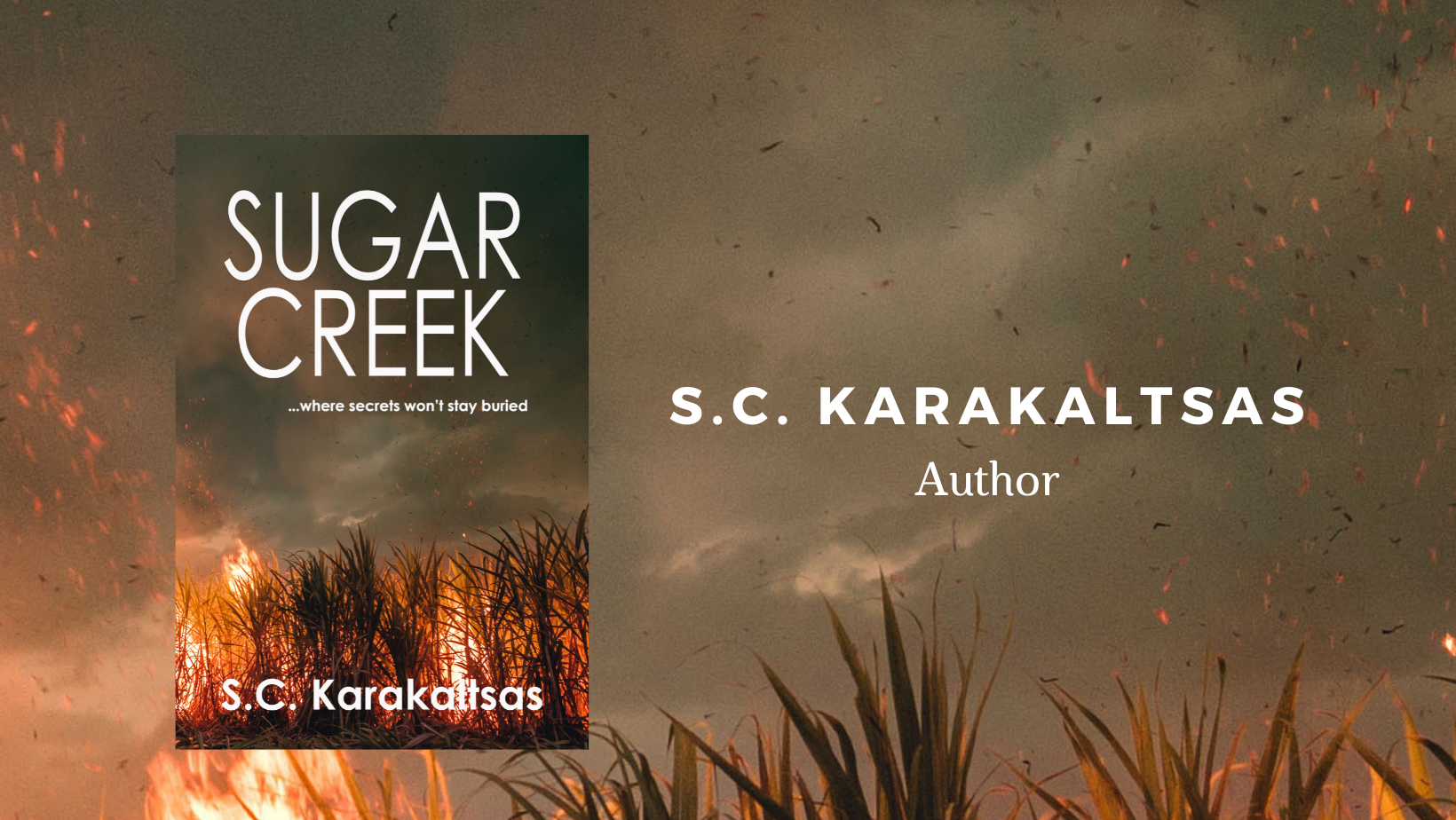
New Book Release: The Good Child by S.C. Karakaltsas

We’re finally out of lockdown mark 6 in Melbourne and after three straight months I’m emerging into a social life and a little retail therapy.

It might look like I’ve spent my days reading and reviewing other people’s books, but in between I’ve been slowly and methodically and sometimes haphazardly writing another historical fiction novel.

It’s taken a little over three years and any writer will tell you that it’s hard work even with a pandemic to distract in between.

The cover was done by the brilliant, Anthony Guardabascio from Continue , and doesn’t it pack a punch of vibrant colour?

About The Good Child:

The Good Child is a compelling story of two very different women: 72-year-old Lucille, with a hidden tragic past, and 30-year-old Quin, whose ambitions lost her everything.

Everyone hates Lucille for what her son Tom, did and she can’t blame them. He’ll probably go to jail. She’s to blame too — she ignored all of his faults perhaps even encouraged them. She never wanted him in the first place. But that wasn’t her first mistake. She’d ignored her grandmother’s warning that if she married the man she loved, her life would be a disaster. She was right too.

Now Lucille’s on a train with no money and no home. All she’s left with is a blind overprotective love for her son, but even that is now pushed to the brink as she comes to terms with her actions and those of Tom’s.

Quin worked for Tom and knows exactly what he’s done because she helped him do it – she turned a blind eye to the corners he cut and the lies he told. Now, she’s lost everything and it’s her own fault. She wants revenge.

Then she meets Lucille on the train and finds herself facing her past and her future.

Rich in detail and epic in scope, The Good Child is a powerful novel of emotional and financial resilience, loss and unexpected friendship.

First Reviews

And the first reviews have started. Check out this lovely 5 Star review for The Good Child 

The Good Child is available on Amazon.com or Amazon.au

Book Review: No Friend but the Mountain: Writing from Manus Prison by Behrouz Boochani


This is a book every Australian should read. But I warn you that it’s a hard one to get through. It’s confronting and uncomfortable, mostly because each of us will feel complicit in allowing our various governments to treat our refugees so badly.

It’s not meant to be a literary masterpiece, instead the writing is a remarkable stream of consciousness smuggled out by text from Manus Island where Boochani was held prisoner for five years. That in itself is an incredible accomplishment deserving of our time to read and absorb every word.

We, Australians have known it as the Manus Island Regional Processing Centre or the Manus Island Detention Centre and after reading Boochani’s account of what life was like, it’s actually worse than any modern day prison – it’s more like a concentration camp.

Boochani relays everything about his experience, and his observations are insightful and confronting. It’s a commentary of humanity under duress and he paints a painstaking and brutal picture in both narrative and poetry. He and other refugees endured cruelty, hardship and tortuous conditions designed to bring them down. What makes someone want to flee their home and take a hazardous boat trip to a place they hope will give them a better life? It’s only someone truly desperate. Yet these refugees were used as pawns in a political plot from which there was no escape.

“We are hostages – we are being made examples to strike fear into others, to scare people so they won’t come to Australia. What do other people’s plans to come to Australia have to do with me? Why do I have to be punished for what others might do?”

This book is more than a description of what life was like for Boochani. It’s an academic analysis of the Australia’s border system described as systematic torture which he labels as the Kyriarchal System.

“The term Kyriarchy was first used by radical feminist theologian Elizabeth Fiorenza in 1992 to describe intersecting social systems of domination and oppression… the term also captures the way the intersecting systems are perpetually reinforced and replicated. This important aspect connects the prison with Australian colonial history and fundamental factors plaguing Australian society, culture and politics. “

You may agree or disagree with Boochani’s analysis but it’s thought provoking. There are numerous examples cited which breached basic human rights, particularly freedom. Use of the telephone was limited, food sparse, communication with the outside world non-existent, disgusting sanitary conditions, and nothing to do.

“A few people were able to get hold of a permanent marker and draw a backgammon board onto a white plastic table. They began to play, using the lids from water bottles as counters. Almost instantly, a group of officers and plain-clothed guards entered … crossed out the game. They wrote over it in bold letters, “Games Prohibited’.”

It was a very difficult book to read during the time of our own lock-down. Then I read a tweet dated 27 March 2020, saying the following: “the refugees being detained at the Mantra Hotel are not being given any soap. ABF (Australian Border Force) said they can apply for it in writing and would take 14 days to approve. “

Don’t we all put our trust in our governments that they will ensure people will be treated with fairness, respect and dignity? This book tells us not to count on it. 

Writing is Hard!

Writers know what I mean. Writing is hard! It’s about finding the story and getting it down in a coherent way. It’s about editing, rewriting, deleting, and thinking and mulling and… I could go on. Wait! I already have.

But it’s also about finding the sweet spot of the story, the joy of a beautiful sentence, of falling in love with the characters, nurturing and cajoling them along and the sadness of leaving them when it comes to the end. It’s all consuming, night and day in your head until it’s time to let it go. Out into the world for others to see, to judge, to like or not.

I’ve been writing my next book for the last eighteen months, pushing it along slowly and methodically at times, researching and looking for the story. The draft is done and there are two stories not one. Parts of it have been rewritten at least three times so far.

Rewriting is not new to me. My first novel was rewritten at least twenty times, my second perhaps ten or more times. I enjoy the editing and rewriting process as I mould the book from rough diamond to something polished and a joy to read (I hope).

Someone said to me yesterday. “Surely it’s easier by now.”  I raised my eyebrows. It’s not easier. Should it be? For me it’s not.  And neither will the next one and the next one after that. There’s no easy shortcut. It doesn’t get done by any other way than sitting/standing in front of a keyboard or notebook or Dictaphone and just writing.

Writing is just plain, hard work!

Let’s chat about reading and writing

Are you looking for something to do next Sunday afternoon in Melbourne? Why not spend a winter’s afternoon in the warmth of Bunjil Place Library? The fabulous library space is set within a newly built arts precinct at 2 Patrick Northeast Drive, Narre Warren.

Every Sunday afternoon, Bunjil Place Library hosts a different author where the community can get up close and ask those burning questions like, how long does it take to write a book? What do you like to read?

Browse through their collection of wonderful books, sit in a comfy snug then come and chat with me about my writing journey and hear all about my books, historical fiction, and short stories and ask your burning questions.

I just happen to be at Bunjil Place Library next Sunday 28 July from 2:00pm until 3:30 pm and you can ask away.

I hope to see you there.

Book Review: Islands by Peggy Frew

I loved Islands. There’s a rhythm of sadness in this beautifully written book as we are led into the lives of various characters and their points of view told in a mix of timelines. The style may not be to everyone’s taste. But my advice is to be patient and perhaps take time to read it to remember everyone.

There was a house on a hill in the city, and it was full, of us, our family, but then it began to empty. We fell out. We made a mess.
We draped ourselves in blame and disappointment and lurched around, bumping into each other. Some of us wailed and shouted; some of us barely made a sound. None of us was listening, or paying attention. And in the middle of it all you, very quietly, were gone.

The Worth family of John and Helen and their young two daughters Junie and Anna could be like any family until Helen has an affair and leaves John. The family begins to splinter slowly in the aftermath of divorce, then completely disintegrates when fifteen-year-old Anna, a troubled and rebellious teen, goes missing. Not knowing how to deal with Anna, Helen decides to give her daughter space, after all, she has taken off before. Blame and tensions arise when Helen fails to report her missing daughter for three days. The unresolved grief about Anna overhangs their lives for years to come.

The landscape is Phillip Island and the imagery is evocative. The house where John’s parents holidayed then retired to is ever-present in the memories of each of the main characters. This imagery is spot on. I know, because I spent my own late teens in a coastal town nearby where my parents owned a holiday house.


“The bald hills crowd in and let go again, and he sails down the last stretch, the flat water below reflecting a half-moon. Past the clustered darkness of the San Remo shops and over the bridge with its tall lights, empty of their daytime perching gulls.”

There are other characters, some of whom you wonder about until the end of their chapter when the connection is revealed.

It’s a remarkable book not just because of the writing but the raw emotion is so moving it stays with you for a long time. Frew’s talent is incredible and I’ll be checking out the rest of her books.

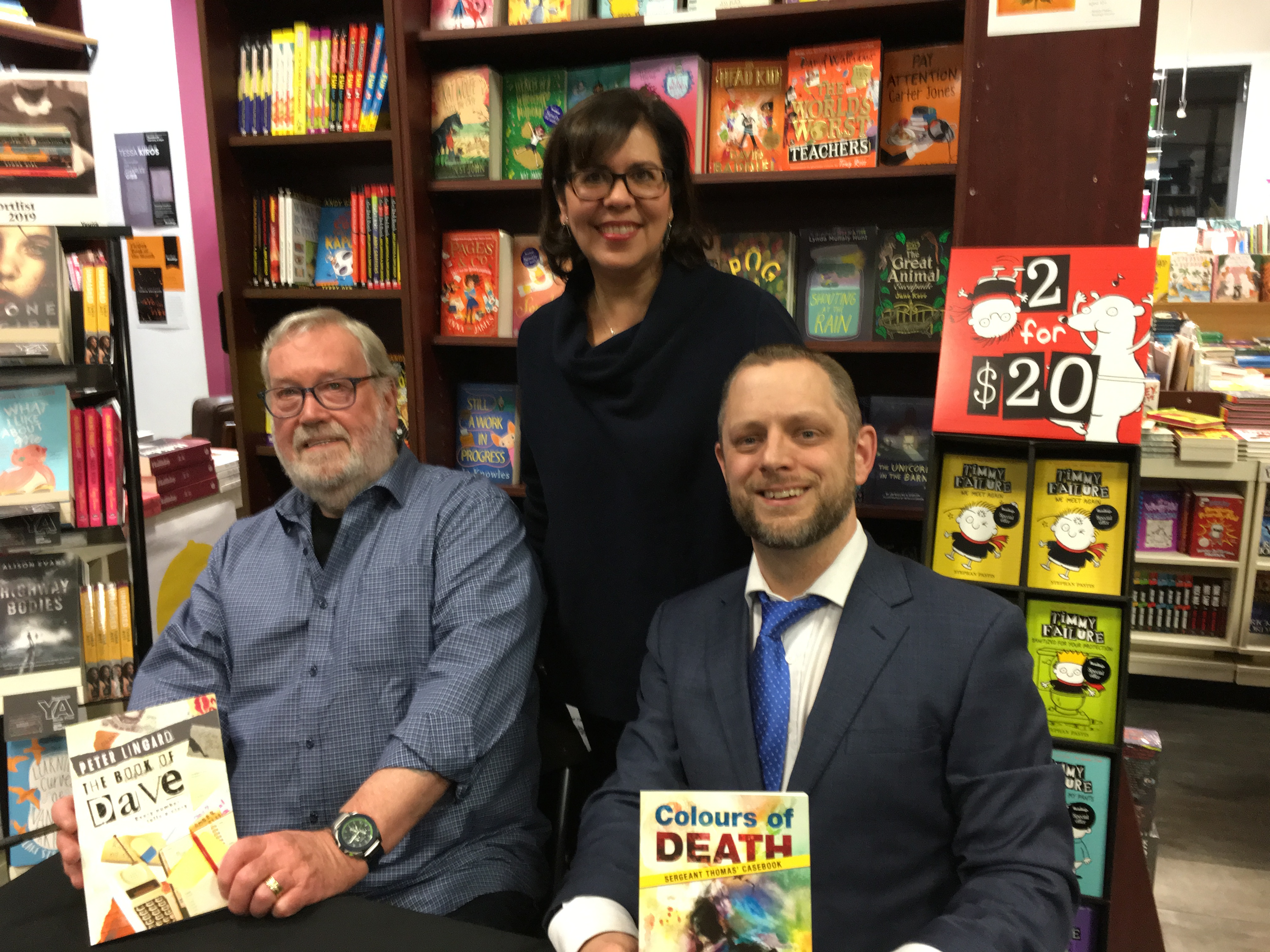
Book Launch: The Book of Dave by Peter Lingard and Colours of Death by Robert New

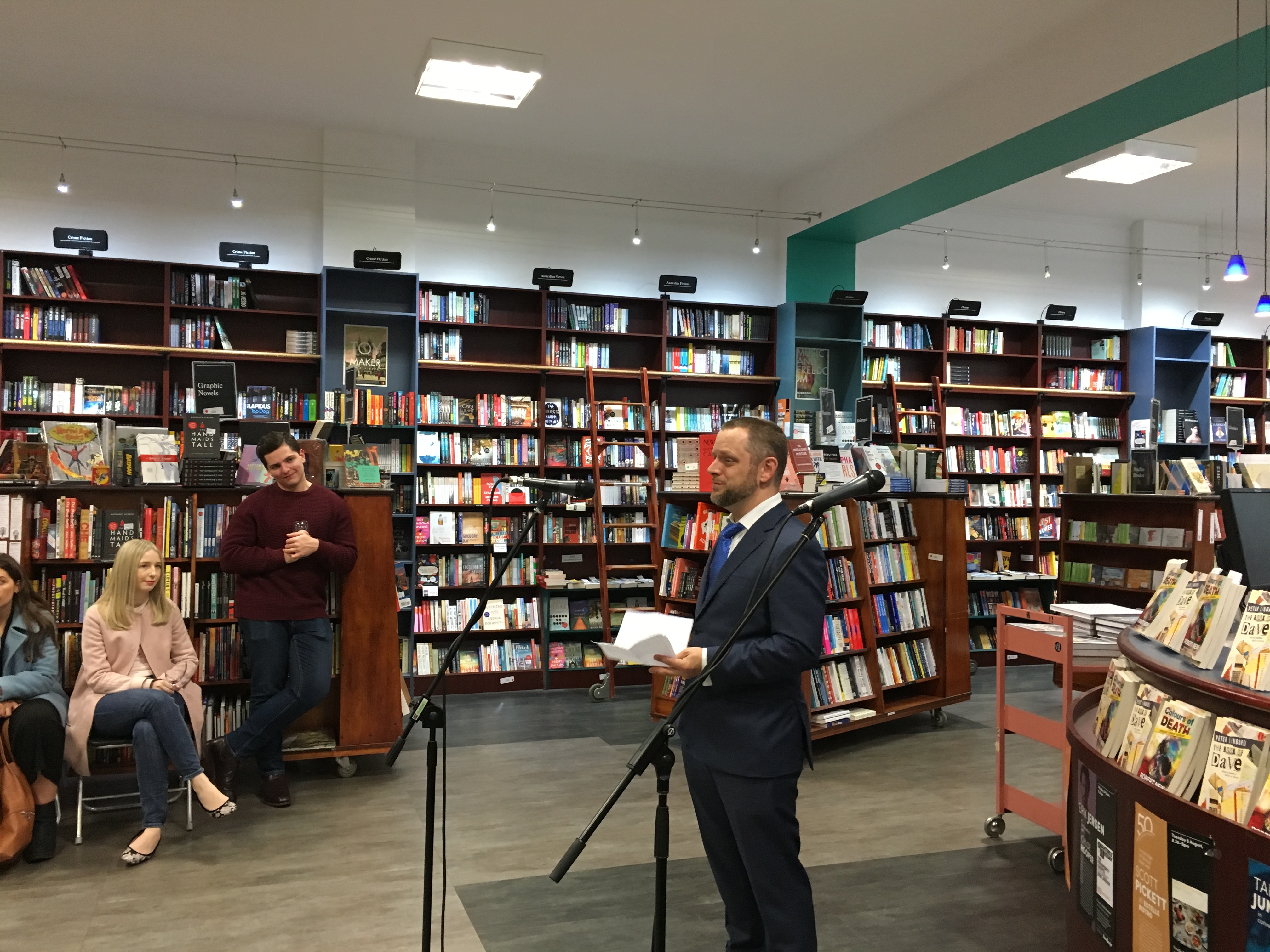
Last night I had the honour of saying a few words and launching two books of short stories for two wonderful writers, Peter Lingard and Robert New at Readings Book Store in Hawthorn.

I met Peter Lingard five years ago when I joined the Phoenix Park Writers Group and admire his writing. Peter has written more than three hundred short stories published in various publications around the world. He’s also written a full-length novel Boswell’s Fairies. (see my earlier review https://sckarakaltsas.com/2017/10/27/book-review-boswells-fairies-by-peter-lingard/) Last night, The Book of Dave was released to the world.

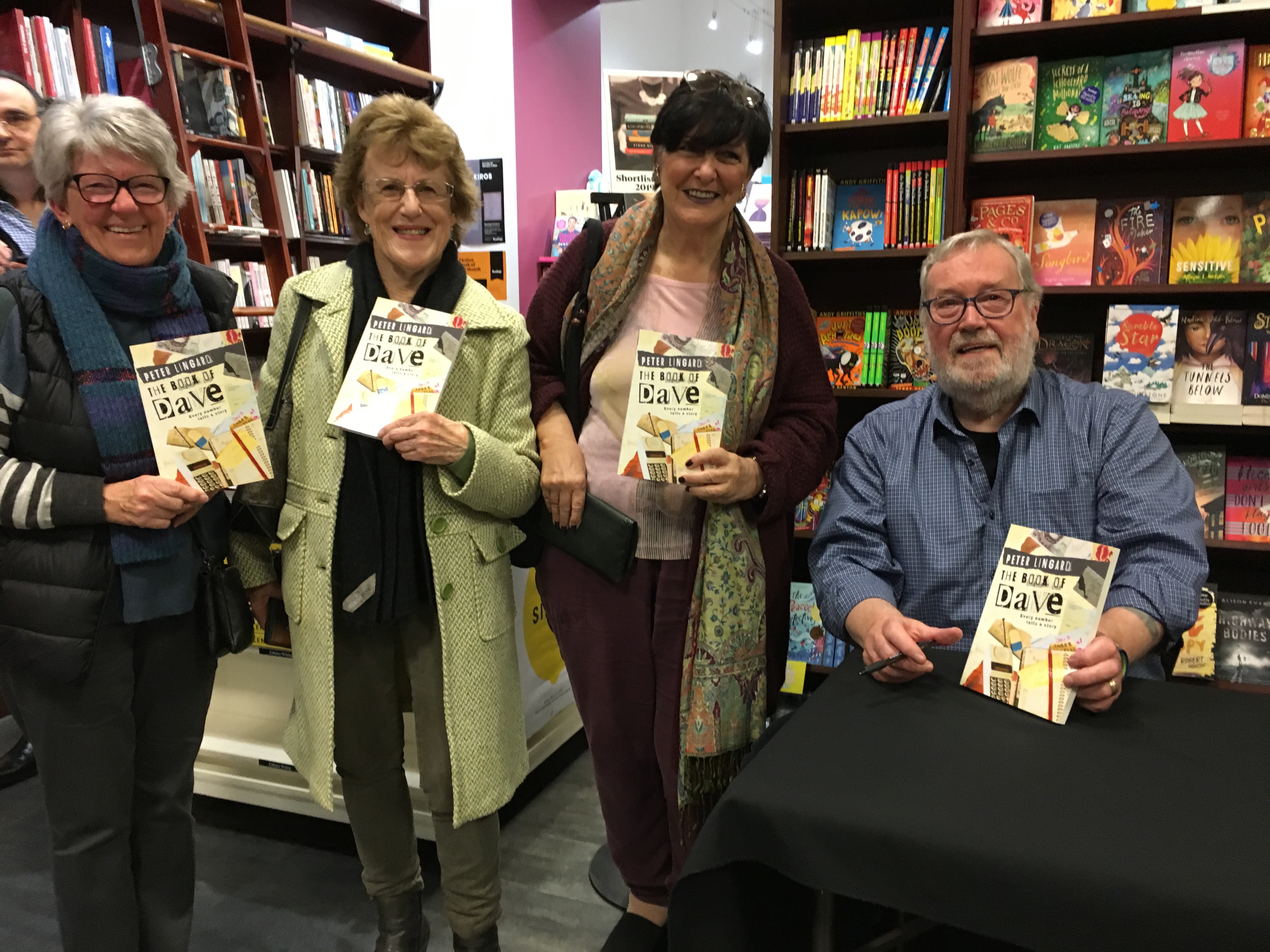
Peter with writers from Phoenix Park Writers Group

A bit about The Book of Dave by Peter Lingard
Dave Wilson is a London barman who, in late December, sifts through telephone numbers accumulated during the year. Each chapter tells the story behind the number.
He joins a band of people who wear pink underwear every Friday, goes to sea in a collier, helps a client sell his invention, takes a sick woman to hospital. Dave becomes friendly with a less than honest policeman, and flies to New York where he falls for an unobtainable woman.

If you ever wanted to get a bird’s eye view at what happens to a barman, this is the book for you. The fact that Peter once worked behind the bar gives some authenticity and he tells each story with humour.

I  also met Robert New five years when I joined Monash Writers Group. He was preparing his second novel, Incite Insight for release and I was writing Climbing the Coconut Tree. We both launched our books three years ago and have supported each other ever since.

Working full time and raising a young family, I asked Robert how he’s been able to write so prolifically and he told me that he simply tries to write at least two hundred and fifty words per day. That’s fewer words than this blog post but over a year adds up. Of course, there are days when he has the time to do more. That’s how he was able to put together Colours of Death. His passion for science shows through in each story as he finds unusual and sometimes bizarre ways people can be murdered.

A bit about Colours of Death: Sergeant Thomas’ Casebook by Robert New
What colour death would you fear the most? This is a collection of nine detective stories where colour plays a role in the mystery.
A high school awards ceremony turns to tragedy when the audience turns blue as they die.
A serial killer’s hair colour could be the key to their capture. An arsonist is trapping people in burning buildings, just to write a story about the rescuers. After a body is dumped in public, working out how the victim died is harder than decoding the intended message.
An incident with the Red Man haunts Detective Thomas, but may also be the key to solving a new case.

There is quite a bit of science behind the stories and you’ll definitely learn something.

It was a privilege to help launch these two books by two wonderful writers and I wish them every success.

Copies are available for sale now. Check them out. Links below:

The Book of Dave by Peter Lingard


https://www.amazon.com/Book-Dave-Peter-Lingard-ebook/dp/B07RG8MH9N/ref=sr_1_1?keywords=The+Book+of+Dave+by+peter+lingard&qid=1561687101&s=gateway&sr=8-1

Colours of Death Sergeant Thomas Casebook by Robert New

https://www.amazon.com/Colours-Death-Sergeant-Thomas-Casebook-ebook/dp/B07RBJR1VJ/ref=sr_1_1?keywords=Colours+of+Death+Sergeant+Thomas%27+Casebook+by+Robert+New&qid=1561687511&s=gateway&sr=8-