Tag Archives: australian authors

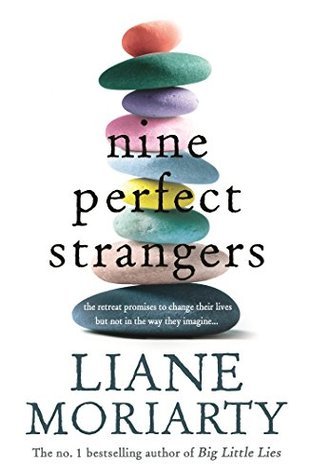
Book Review: Nine Perfect Strangers by Liane Moriarty

Courtesy of Goodreads

I’ve always wanted to read one of Liane Moriarty’s books but never have. I feel as though she’s an author who’s been read by everyone and it’s taken me this long to take the plunge. So instead of starting from her first, I’ve started with her latest, Nine Perfect Strangers.

The title more or less gives it away – it’s about nine individuals who have come together in a health retreat hoping to get well. They get much more than they bargained for – a true transformation which will change their lives forever.

I’ve actually never been to a health retreat. The descriptions of the health spa were intoxicating and I almost felt like I was there luxuriating in the massages, gentle walks, Tai Chai and delicious food and I was just about ready to book myself into one. Half way through the story though things got interesting as the challenges each of the nine faced was ramped up a notch or two.

The characters, and there are at least eleven, are largely white and middle class and I didn’t find them particularly likeable. I could forgive that I didn’t feel too much for the characters – just like when you go to a party or a conference, you get to know people but don’t have to actually like them – that is kind of what I felt about them all. The switch between their point of view meant that we stayed with them just enough. There was however, a bit too much repetition about their backstories which I found a little tedious. For example, we’re told on numerous occasions that Carmel has four children and thinks she’s fat even though she isn’t. I didn’t find her particularly engaging as a character and the change in her came a little too late for me. Like Carmel, none of them really developed the way I’d hoped. Frances was the one character who we grew to know a bit more than the others and although a bit wacky, I didn’t warm much to her either.

When the owner of the resort, Masha goes rogue, I unconsciously rolled my eyes. Masha, a supposedly strong, determined yet narcissistic woman has demons which begin to play out in weird ways. The story twists into an almost unbelievable farce which I found a little hard to swallow. There’s quite a bit of commentary about body image and the author does tackle mental health issues particularly suicide which all seemed at odds to the bizarre turn of events. Perhaps this story didn’t go far enough. I won’t give away spoilers but it takes an almost comic and predictable turn nicely tied up neatly at the end, which funnily enough, was exactly what I wanted.

This is an easy and quick read and although not a literary masterpiece would be an ideal, very light, holiday read. Have I booked a health retreat yet? Nah, somehow I don’t think it’s me. Would I try another book from this author? Yep, probably just to compare it this one.
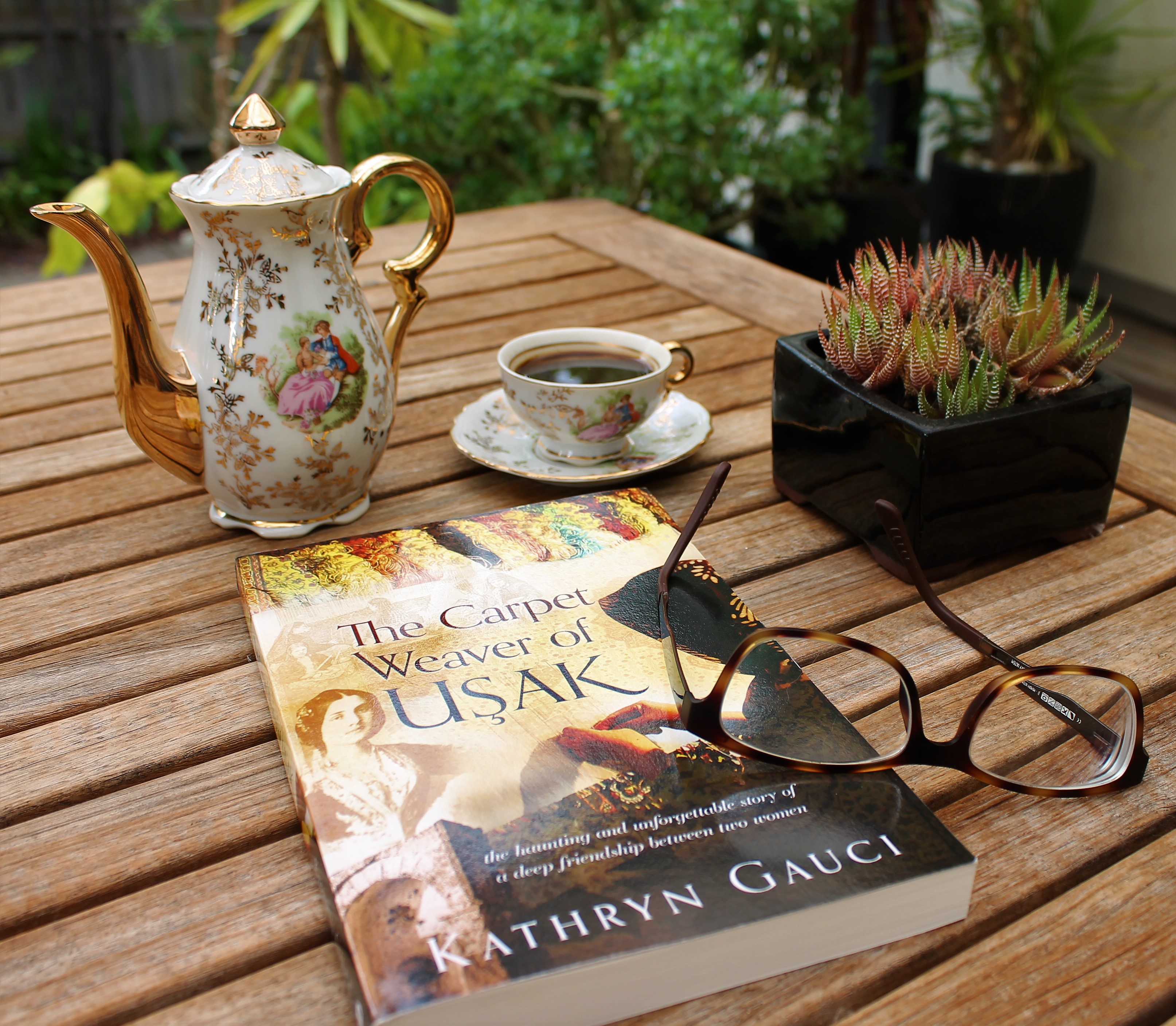
Book Review: The Carpet Weaver of Usak by Kathryn Gauci


Set in a village called Stavrodomi not far from the town of Usak, Anatolia, a Greek couple, Christophorous and his young bride, Aspasia live an idyllic life, side by side with their Turkish neighbours who call their half of the village, Pinarbasi. Christophorous works for the Anatolian Carpet Manufacturers Ltd as a carpet manager and Aspasia is a carpet weaver who weaves the most sought after pieces with her long time Turkish friend, Saniye. The demand for quality carpets is high and life is good in early 1914.

But their bliss is shattered with the onset of World War 1 when the men of the village are forced to fight in horrific conditions for a cause they don’t understand. Not long after the end of the war, another conflict starts up when Greece invades in 1919. The two nationalities are pitted against each other and as the war progresses the Greek population are sent back to Greece despite the fact that they and their ancestors had lived there for generations. The two wars are particularly pivotal in shaping modern day Turkey and Greece, despite some testing years since.

It’s a fascinating time and is a particularly enlightening read. The description of the carpet weaving is a lesson in how it was done and reminded me of my visit to Turkey a few years ago when I witnessed first-hand, the intricacies of weaving. Indeed, weaving and spinning was one of the few skilled occupations dominated by women giving their families a solid and reliable income. It’s not surprising that the detail is so fascinating as the author herself worked in Greece for a number of years as a carpet designer.

Throughout the story, the reader is immersed in the daily lives of the three main characters, particularly the women and we learn how they live – their fears, their loves and their superstitions. Indeed, the description of  food so very central in their lives, was mouth-watering – lamb koftes, stuffed aubergines, goats cheese and black olives ‘… she threaded pieces of meat that had been marinating in olive oil, lemon and herbs onto skewers and place them over the coals.’

The atrocities of war and its toll on Christophorous and Aspasia is heartbreaking but out of war comes hope and strength as ordinary people who care for each other stand up in support of what they know is right. It’s a beautiful story of love and adversity and the power and sacrifice for friendship.

The Carpet Weaver of Usak is the third book where Kathryn Gauci writes about Greece and Turkey. For more check out her webpage

Copy was provided courtesy of the author with thanks.


Book Review: Boy Swallows Universe by Trent Dalton

This is an amazing book and is a must read. If you haven’t heard about it, I predict you will because I’m fairly confident this will be winning prizes in 2019. There I’ve said it, but why?

The book is written from the point of view of a thirteen-year-old boy, Eli growing up in Brisbane whose best friend Slim is his babysitter who just happens to be a notorious ex-crim, his stepfather is a drug dealer, his mother ends up in jail and his older brother, August is mute. If that doesn’t get you going, then throw in the boy’s philosophical yearning to know if a man can ever be good as he takes a long hard look at the role models of adult men around him.

The writing is sublime.

Still night air and two boys smoking on a gutter. Stars up there. A cane toad down here has been flattened by a car tyre on the bitumen road a metre from my right foot. Its pink tongue has exploded from its mouth so it looks like the toad was flattened halfway through eating a raspberry lolly snake.

‘Sucks, doesn’t it?’ Darren says.
‘What?’
‘Growing up thinking you were with the good guys, when all along you were running with the bad guys.’

The cover is incredible.

I’ll almost bet that you’ll turn back if you walk past a bookshop with this cover in the window, just to take a look.

The splat of pink and orange with a small bird sitting on a statement, ‘your end is a dead blue wren’ is intriguing. That statement will mean a lot and by the time you finish the book you will understand why.

The descriptions are exquisite.

Slim coughs, chokes up brown tobacco spit that he missiles out the driver’s window to our sun-baked and potholed bitumen street running past fourteen low-set sprawling fibro houses, ours and everybody else’s in shades of cream, aquamarine and sky blue. Sandakan Street, Darra, my little suburb of Polish and Vietnamese refugees and the Bad Old Days refugees like Mum and August and me, exiled here for the past eight years, hiding out from the rest of the world, marooned survivors of the great ship hauling Australia’s lower- class shitheap, separated from America and Europe and Jane Seymour by oceans and darn pretty Great Barrier Reef and another 7000 kilometres of Queensland coastline and then an overpass taking cars to Brisbane city, and separated a bit more still by the nearby Queensland Cement and Lime Company factory that blows cement powder across Darra on windy days and covers our rambling home’s sky-blue fibro walls with dust…

The plot and characters are well-developed.

From the first page you’ll be put into the rollercoaster’s front seat which barely lets up until close to the end when you’ll wonder why you have palpitations in your chest. At times, you’re unsure whether you should laugh or cry or merely gasp at the almost farcical nature of the boy’s life, where you wonder if he can survive another distressing obstacle. Eli makes us see a different side to people we’d automatically dismiss.

“I love Slim because he truly loves August and me… I love him so much for convincing us that when Mum and Lyle are out for so long like they are at the movies and not, in fact, dealing heroin purchased from Vietnamese restaurateurs.

You just can’t help but fall in love with Eli and his brother, August. You’ll despise their arch enemies and hope like hell that there can be a better life for them both.

It is a wondrous book full of heart and soul. Get a copy, any way you can.

Book Review: The Nowhere Child by Christian White


What would you do if you found out from a stranger that he suspects you are a missing girl, named Sammy, who may have been abducted when you were two from another country? This is the basic premise of a book which is full of suspense and twists right until the end.

Kim Leamy is the woman who has been approached and after initially brushing off the idea, she begins a quest into her family history. Her mother is already dead so she can’t ask her and the more she questions the more difficult it is to find logical answers. Her digging takes her to unexpected places with almost disastrous outcomes.

I’d heard a bit of hype and had actually seen the author talking about his debut novel at a couple of events and after reading it, I was not disappointed.

It’s much more than a kidnapping and whodunit story as the author explores trauma, cults and religious zealotry. The alternating stories between past and present was superbly done and as a reader we feel Kim’s gradual realisation,her confusion and pain.

I finished this one in two days so immersed was I in it. Highly recommend it.

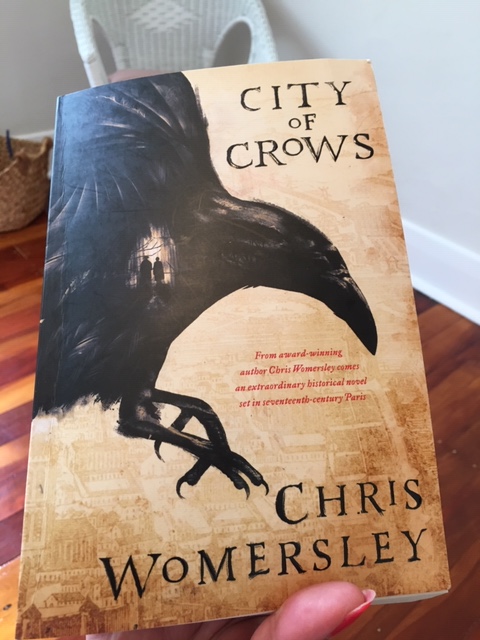
Book Review: City of Crows by Chris Womersley

Set in 1673 France, Charlotte Picot grieves the death of her husband and with her only child Nicolas, she flees her small village to save him from the plague which sweeps across the country. Along the way, Nicolas is stolen from her and she is left for dead. Rescued by an old woman who brings her back from the brink of death, Charlotte continues her quest to find her son who she fears has been taken to Paris to be sold. Along the way, she meets Lesage, recently freed from jail and together they begin a journey filled with fear, rogues and superstition.

‘Grief was an unpredictable burden for a woman; it killed or deranged some, yet made warriors of others.’

This novel is beautifully written and is the second of this author’s novels I’ve read. Like his earlier novel, Cairo, this one is hard to put down. The language is evocative and the descriptions put you into a place so full of hardship, we’re grateful to have been born in a different time. I loved the idea that ignorance and lack of education heightened Charlotte and Lesage’s superstitions of sorcery and magic for explanation of events which today, with the knowledge of science, would be easily explained. Witches, sought after for many things were revered and feared.

‘Monsieur Maigret placed the skull back on the shelf. “You know, they are hanging Justine Gallant and Monsieur Olivier at Place de Greve tonight. For murder. Witchcraft. They say they tried to summon the Devil himself.”‘

It is also a story of a woman’s grief for her family and her sheer desperation to do whatever she has to do to get her son back despite the consequences. What she does towards the end is shocking and takes your breath away and there is quite a bit of controversy over the ending. All in all an enjoyable and engaging read.

Book Review: What the Light Reveals by Mick McCoy

Military secrets, spying for the Russians, fear and discrimination for your beliefs – this is an intriguing tale about what a communist’s life was like in fifties Melbourne. Conrad and Ruby, members of the communist party with one adopted son and another on the way are treated as outcasts after Conrad is falsely accused of spying for the Russians. Watched by ASIO, unemployed and their reputation in tatters they are forced to flee Australia to live in Russia.

The story diverges into not just about life in Russia but what happens to a family with secrets who never feel they belong in their adopted country and where every movement is under scrutiny. But this book is so much more than that. The characters are well developed as we are privy to the points of view from Conrad, Ruby, Alex, (the elder and adopted son) and Peter, the biological son.

Fast forward to Russia in the early seventies and this is where the family almost implodes from secrets and lies and where their very survival is tested. Are the ideals held so closely while living in a Western country destroyed by the reality of living in a communist state?

 “In a sudden breathless cleft between sleep and wakefulness, in darkness, eyes wide, mouth open, she listened for the rumbling of the tanks, the gravel-crunch of soldiers boots, the whispered metallic click of rifles being readied to fire. Nothing. She waited for her heart to settle. Breath by breath she let go. “

They belong to neither country and the only thing they do have is each other. When tragedy strikes, we feel for each of them as they’re torn apart by distrust, anger and grief. Alex, whose path was set by his parents is bewildered and his vulnerability is touching as he comes to grips with what his future holds.

This is a wonderfully written novel inspired by the authors own aunt and uncle. He borrows a lot from them to give us an insight into two worlds. It’s not often that a reader gets to meet the author, to hear him speak of what he did over a fourteen-year time span to research, interview, and write a story. It surely is a labour of love.

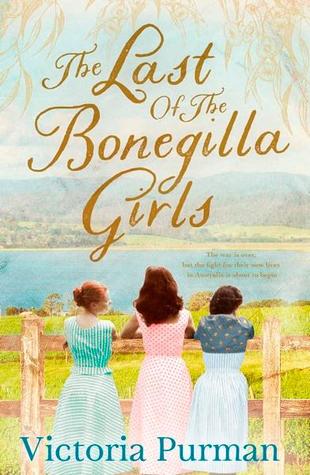
Book Review: The Last of the Bonegilla Girls by Victoria Purman


Can you picture being in a camp cramped with thousands of migrants hoping for a new life after living through the worst hardship and mayhem in your own country? Bonegilla Migrant Camp near Albury, Australia was one such place which temporarily housed thousands of migrants from all walks of life from Europe and Britain. Each of these migrants came to Australia for a new start in life – for a better life.

Put four sixteen-year-old girls together from different racial backgrounds and a life-long friendship develops. There is Elizabeta from Hungary, Vasiliki from Greece, Iliana from Italy and Frances, the Australian girl whose father is the Camp director. The reader is taken through an epic journey learning about each girl and their families through their eyes. While there are many characters, which could be overwhelming, it isn’t because the author gives us enough time with each one.

The girls grapple with their own problems not just because they’re migrants, but because they’re women in a conservative 1950’s Australia. Purman shines a light on a society where teenage pregnancies and hidden love because of racial, class or religious differences aren’t tolerated and where indiscretions are kept secret because the consequences are too traumatic.

The difficulties they face are many and in particular, the story of Elizabeta and her family is gut-wrenching. The exploration of mental health issues for migrants is explored in just enough detail for the reader to appreciate the generational impact. The racism of being a “New Australian” is very real, and this book provides an understanding of what being new to a country is like, serving as a reminder for tolerance and empathy for today’s new migrants.

This was a big undertaking for the author as we’re taken into the sixties, seventies and eighties. The reunions with the girls as grown women with their own families provides a picture of what’s happened to them. The last part of the book skips years from 1994- 2018 and I yearned to know more. Does Frances finally get her happy ever after? We’re left to join the dots. But isn’t the job of the author to leave us with our imagination? Reaching the end, I was glad the story of each girl wasn’t wrapped up in a bow with a Hollywood ending because life really isn’t like that.

This is an enjoyable and well-written historical novel with tragedy, love and friendship in a harsh landscape where the only option is hard work and survival. According to the author, “One in twenty Australians have links to Bonegilla”, so you too might have a connection. Who knows?